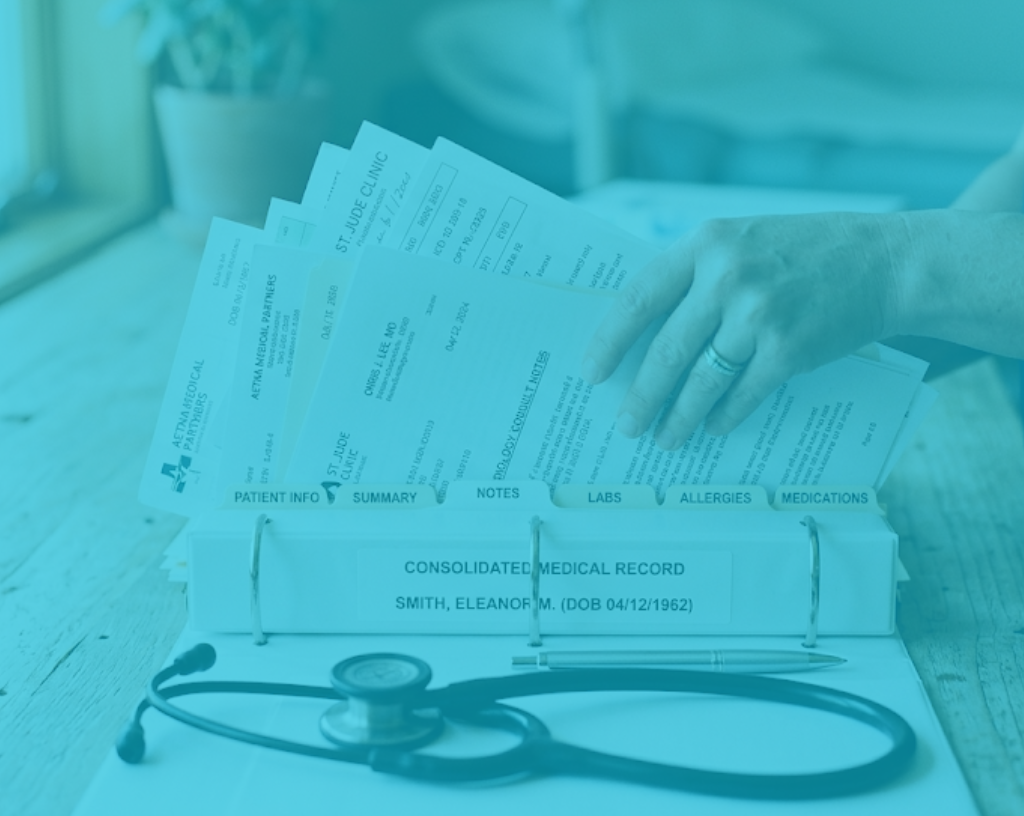
In personal injury and mass tort litigation, cases involving multiple healthcare providers are among the most complex to manage. A single case may include records from hospitals, primary care physicians, specialists, therapists, and diagnostic centers, each documenting care independently.
While this volume of medical data strengthens the case, it also creates a major challenge. Information becomes fragmented, timelines are difficult to reconstruct, and inconsistencies are harder to detect.
Trivent Legal’s centralized platform, built on an Expert Intelligence framework, simplifies multi provider cases by organizing all medical data into a unified, structured system. Instead of navigating disconnected records, attorneys gain a clear, complete view of the case.
Why Multi Provider Cases Are Difficult to Manage
Medical care is rarely centralized. Each provider documents treatment separately, leading to:
- Disjointed timelines across providers
- Inconsistent terminology and documentation styles
- Repetition of information in multiple records
- Conflicting medical opinions
- Difficulty tracking treatment progression
Manually reviewing and aligning these records is time consuming and increases the risk of missing critical details.
What a Centralized Platform Changes
Trivent Legal’s platform consolidates all provider data into a single structured environment.
Attorneys can:
- Access all medical records in one place
- View unified treatment timelines
- Identify connections between providers
- Detect inconsistencies across documentation
This eliminates fragmentation and simplifies case analysis.
1. Creating a Unified Medical Timeline Across Providers
One of the biggest challenges in multi provider cases is aligning treatment chronologically.
The platform allows attorneys to:
- Merge records from all providers into one timeline
- Track patient movement between providers
- Identify gaps or overlaps in care
- Understand the full sequence of treatment
This unified view is critical for building a clear case narrative.
2. Connecting Provider Interactions Clearly
In multi provider cases, care is often interconnected.
The platform helps attorneys:
- Identify referrals between providers
- Track follow ups after specialist consultations
- Understand how one provider’s findings influenced another’s treatment
- Analyze coordination of care
This clarity strengthens both causation and treatment progression arguments.
3. Detecting Conflicting Medical Opinions
Different providers may document varying diagnoses or treatment approaches.
With a centralized view, attorneys can:
- Compare provider observations side by side
- Identify inconsistencies in diagnosis
- Detect differences in treatment recommendations
- Prepare strategies to address conflicts
Early identification of these issues is essential for effective case preparation.
4. Tracking Treatment Progression Across Multiple Providers
Treatment progression becomes more complex when multiple providers are involved.
The platform allows attorneys to:
- Follow the evolution of treatment across providers
- Identify escalation from general care to specialized intervention
- Track long term management patterns
- Understand how care developed over time
This structured insight strengthens case strategy.
5. Identifying Gaps and Missing Information
Multi provider cases often contain missing or incomplete records.
The platform helps attorneys detect:
- Missing provider records
- Gaps in treatment between providers
- Unavailable diagnostic reports
- Incomplete follow up documentation
- Early detection allows attorneys to address these issues before they impact the case.
6. Reducing Manual Review and Complexity
Without a centralized system, attorneys must:
- Review records provider by provider
- Manually reconstruct timelines
- Cross reference multiple documents repeatedly
The platform eliminates this by:
- Providing structured, organized case data
- Allowing instant access to key insights
- Reducing repetitive manual analysis
- This significantly improves efficiency.
7. Strengthening Causation and Damages Analysis
Multi provider cases often involve complex causation and damages arguments.
With a centralized platform, attorneys can:
- Clearly link treatment across providers to the injury
- Demonstrate continuity of care
- Identify escalation patterns supporting severity
- Connect treatment to financial impact
This improves both negotiation and trial positioning.
8. Improving Team Collaboration on Complex Cases
Multi provider cases typically require collaboration across legal teams.
The platform allows teams to:
- Work from the same structured data
- Maintain consistent understanding of the case
- Reduce duplication of effort
- Share insights efficiently
This ensures alignment across all stakeholders.
From Fragmented Records to Structured Case Clarity
Traditionally, attorneys must piece together multi provider records manually.
With Trivent Legal’s platform, they move from:
- Disconnected documents
to - Unified case visibility
Instead of:
- Reconstructing timelines
they - Access them instantly
This transformation simplifies even the most complex cases.
Why This Matters in High Volume Litigation
For firms handling multiple complex cases, managing multi provider records manually is not scalable.
The platform enables attorneys to:
- Handle complex cases efficiently
- Maintain consistency across cases
- Reduce preparation time
- Improve overall case quality
This creates a significant competitive advantage.
The Expert Intelligence Advantage
Trivent Legal’s centralized platform is powered by Expert Intelligence, ensuring that:
- Medical data is structured by medical professionals
- Provider interactions are clearly mapped
- Insights are clinically meaningful
- AI enhances speed and usability
This combination delivers both depth and efficiency.
Final Thoughts
Multi provider cases are inherently complex, but that complexity does not have to slow down case preparation or weaken strategy.
Trivent Legal’s centralized platform simplifies these cases by organizing fragmented medical records into a clear, unified system that attorneys can use effectively.
By transforming complexity into structured insight, attorneys can build stronger cases, reduce inefficiencies, and improve outcomes across even the most challenging litigation.