Introduction
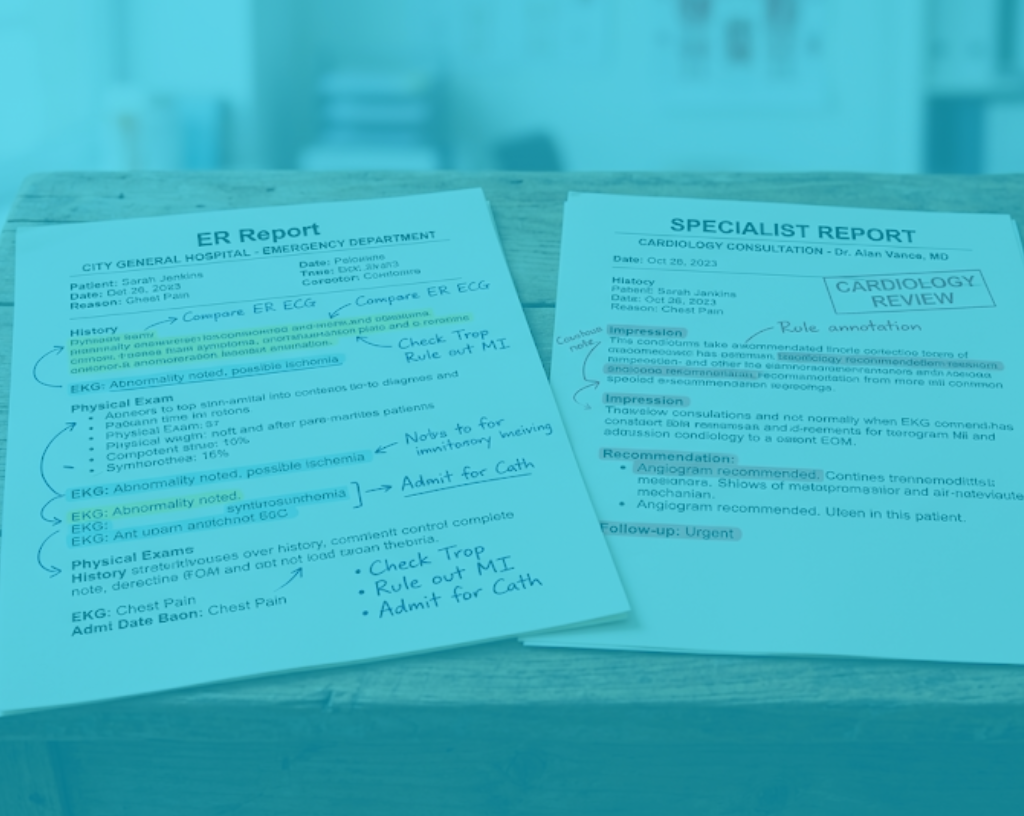
In personal injury and medical negligence cases, consistency across medical records is critical to establishing a clear and credible narrative. However, when treatment spans multiple providers, differences in documentation can arise. Emergency room records often capture the initial presentation, while specialist reports reflect later evaluations. When these records do not align, it can create confusion, weaken causation arguments, or open the door for defense challenges.
Attorneys must identify and address such inconsistencies early in the case. This case study demonstrates how Trivent Legal’s Case Intelligence Platform helped attorneys detect discrepancies between emergency room documentation and subsequent specialist reports, enabling a more accurate and defensible case strategy.
Background
The case involved an adult plaintiff who presented to the emergency department following an incident resulting in injury. Initial ER records documented:
- Acute pain complaints
- Physical examination findings
- Preliminary diagnosis
- Discharge instructions
The patient later sought care from specialists, including orthopedic and neurological providers. These specialists documented:
- Updated diagnoses
- Imaging findings
- Treatment recommendations
- Functional limitations
The medical records spanned multiple providers and facilities, with documentation delivered in separate batches over time.
While reviewing the case, the attorney suspected that certain aspects of the specialist findings did not fully align with the initial ER documentation.
To investigate further, the legal team engaged Trivent Legal to analyze the records using the Case Intelligence Platform.
Attorney Challenge
The legal team faced several key challenges:
- Large volume of records across multiple providers
- Differences in terminology between ER and specialist documentation
- Difficulty aligning timelines of symptoms and diagnoses
- Risk that inconsistencies could weaken causation arguments
- Limited time to manually cross reference records
Without a structured comparison, identifying and understanding these discrepancies would require extensive manual review.
Trivent Legal’s Expert Intelligence Approach
1. Centralized Record Integration
All medical records were ingested into the Case Intelligence Platform and organized into a unified dataset.
This included:
- Emergency department records
- Specialist consultation reports
- Imaging studies
- Follow up treatment notes
Records were structured chronologically and linked by date, provider, and encounter.
2. Side by Side Timeline Comparison
The platform enabled a clear comparison between:
- Initial ER findings
- Subsequent specialist evaluations
By aligning records within a single timeline, analysts could track how diagnoses and symptoms evolved over time.
3. Identification of Documentation Discrepancies
During the review, several inconsistencies were identified:
- Symptoms documented in specialist reports that were not emphasized in ER records
- Differences in injury severity descriptions
- Variations in diagnosis terminology
- Imaging findings that were not referenced in earlier documentation
These discrepancies highlighted areas requiring further analysis.
4. Contextual Clinical Analysis
Trivent Legal’s clinical analysts evaluated whether these inconsistencies represented:
- True differences in clinical findings over time
- Documentation gaps during initial evaluation
- Evolution of symptoms after the incident
- Differences in provider focus or specialty
This step ensured that discrepancies were interpreted accurately rather than treated as isolated contradictions.
5. Integration into Case Insights
The identified inconsistencies were documented within the platform’s case insights, allowing attorneys to:
- Understand where records diverged
- Access supporting documentation quickly
- Prepare explanations for these differences
This transformed raw discrepancies into actionable legal insights.
Key Insights Revealed
The platform revealed several important findings.
First, some symptoms documented by specialists were present at the time of the ER visit but were not fully detailed in initial records.
Second, diagnostic clarity improved over time as imaging and specialist evaluations provided more detailed information.
Third, differences in terminology reflected varying clinical perspectives rather than conflicting facts.
Finally, the progression of documentation demonstrated that the patient’s condition evolved, which explained certain variations between early and later records.
Litigation Value Delivered
The identification and analysis of inconsistencies provided several strategic advantages.
Stronger Causation Narrative
Attorneys were able to explain how symptoms progressed from initial presentation to specialist diagnosis.
Preemptive Defense Strategy
Potential challenges based on record discrepancies were addressed before they could be raised by opposing counsel.
Improved Case Clarity
The legal team gained a clearer understanding of how different providers documented the same condition.
Efficient Record Navigation
Supporting documents could be accessed quickly within the platform.
Enhanced Expert Collaboration
Medical experts were able to review discrepancies within a structured context.
Outcome
With the inconsistencies identified and analyzed, the legal team was able to present a cohesive explanation of the patient’s medical journey. Rather than appearing contradictory, the records were understood as part of a continuous clinical progression.
This clarity allowed attorneys to strengthen their case strategy and prepare for potential challenges during negotiation or litigation.
Counsel reported that the platform significantly reduced the time required to identify discrepancies and improved their ability to address them effectively.
Conclusion
In complex cases, differences between emergency room records and specialist reports can create uncertainty and weaken case narratives if left unaddressed. Identifying and understanding these discrepancies is essential to building a strong legal argument.
This case demonstrates how Trivent Legal’s Case Intelligence Platform helps attorneys detect, analyze, and contextualize inconsistencies across medical records. By transforming fragmented documentation into a structured and comparable format, Trivent Legal enables legal teams to maintain clarity, strengthen causation, and prepare with confidence.
Through Expert Intelligence, attorneys gain the ability to turn potential weaknesses into well explained, defensible components of their case strategy.