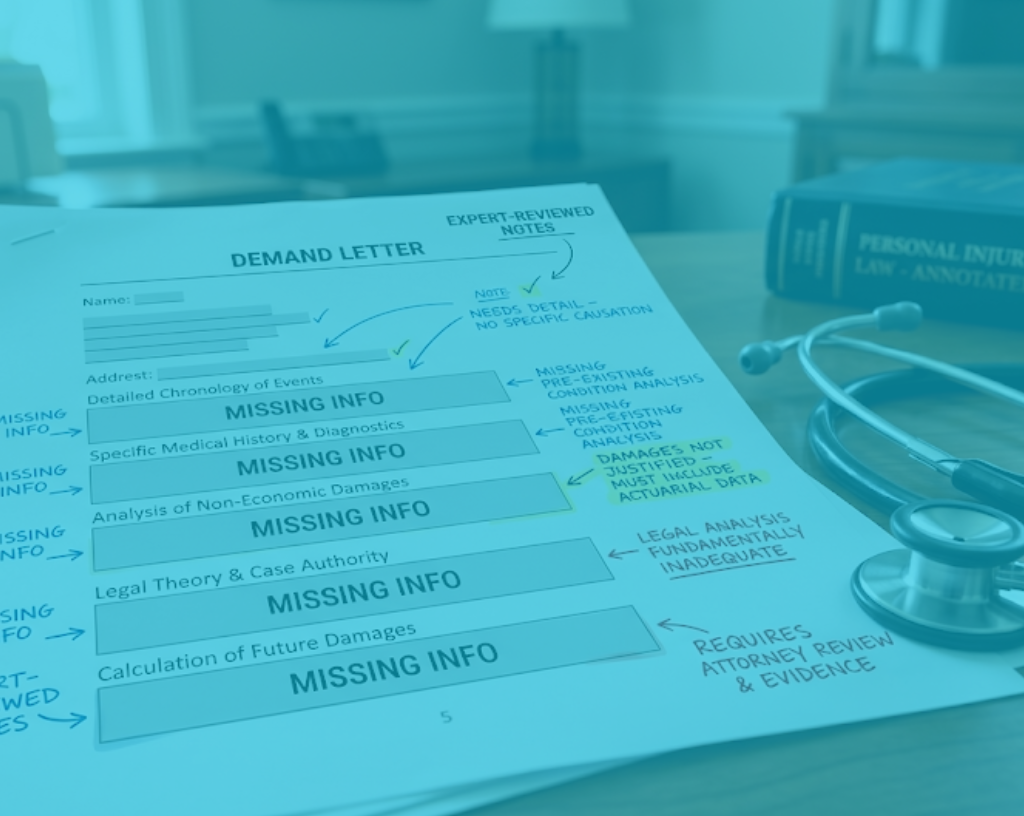
AI generated demand letters are becoming increasingly common in personal injury litigation. Many services promise rapid turnaround, automated case summaries, and instant settlement demands generated from medical records.
However, high value injury claims require far more than automation.
A demand letter is not simply a collection of medical facts and billing totals. It is a strategic negotiation document designed to influence how insurance carriers evaluate causation, damages, liability exposure, and long term risk.
In catastrophic injury cases, spinal surgery claims, traumatic brain injuries, chronic pain litigation, and other high exposure matters, AI generated demand letters often fail to deliver the settlement outcomes attorneys expect.
The reason is simple.
Automation can summarize information, but it cannot replace medically informed litigation strategy.
Here are four major reasons why AI generated demand letters frequently underperform in high value personal injury claims.
1. AI Generated Demand Letters Often Lack Strategic Medical Narrative
One of the biggest weaknesses of AI generated demand letters for personal injury cases is the absence of a clinically persuasive narrative.
AI systems typically summarize:
- Dates of treatment
- Diagnoses
- Procedures performed
- Medical expenses
But high value negotiations depend on something much more important:
- Why treatment escalated
- How symptoms progressed
- Why future care is necessary
- How the injury changed the claimant’s life
Medical experts understand how to organize treatment progression into a narrative that strengthens damages and settlement positioning.
Without this clinical context, AI generated demand letters often feel generic and less persuasive to insurers.
Why This Matters in High Value Claims
Insurance adjusters reviewing catastrophic injury cases are not simply reading medical summaries.
They are evaluating:
- Severity of injury
- Long term exposure
- Permanency risk
- Future medical liability
- Jury appeal potential
A weak narrative reduces negotiation leverage significantly.
2. AI Cannot Properly Analyze Complex Causation Issues
Causation is one of the most heavily contested issues in high value personal injury litigation.
AI generated demand letters frequently fail to identify:
- Delayed symptom onset
- Treatment gaps affecting causation
- Pre existing degenerative conditions
- Multi provider inconsistencies
- Weaknesses in treatment progression
As a result, the demand letter may present the claim as straightforward while ignoring vulnerabilities that insurers will immediately recognize.
Medical expert driven demand letter services help attorneys proactively address these issues before negotiation begins.
Why This Weakens Settlement Positioning
If causation concerns are not addressed strategically inside the demand package, insurers are more likely to:
- Challenge treatment necessity
- Minimize injury severity
- Reduce settlement offers
- Delay negotiations
Strong demands anticipate defense arguments rather than reacting to them later.
3. AI Generated Demands Often Miss Long Term Damages Exposure
High value injury claims frequently involve future medical exposure that significantly impacts settlement value.
Medical experts recognize patterns indicating:
- Chronic pain management
- Future surgery risk
- Long term rehabilitation needs
- Permanent functional limitations
- Ongoing medication dependency
AI generated settlement demand letters may summarize ongoing care without understanding its impact on future damages.
This creates demand packages that undervalue the true long term exposure of the case.
Why Future Damages Matter
In catastrophic injury litigation, settlement value is often driven more by future exposure than past treatment.
Without medically informed analysis, AI generated demands may fail to communicate:
- Permanency
- Long term impairment
- Chronic management patterns
- Future medical cost implications
This weakens overall negotiation strength.
4. AI Generated Demand Letters Lack Litigation Strategy
A demand letter is not just documentation.
It is negotiation strategy.
Strong insurance demand letters are built around:
- Anticipating insurer defenses
- Highlighting medically persuasive evidence
- Structuring damages strategically
- Presenting treatment progression logically
- Maximizing perceived litigation risk
AI systems generate summaries based on patterns and prompts, but they do not think strategically about:
- Jury perception
- Defense arguments
- Settlement leverage
- Litigation exposure
Medical expert driven demand preparation helps attorneys position cases for stronger outcomes long before mediation or trial begins.
The Difference Between Automated Summaries and Litigation Ready Demand Letters
AI generated demands are often effective at producing basic summaries quickly.
However, high value personal injury litigation requires:
- Clinical interpretation
- Strategic causation presentation
- Damages positioning
- Persuasive treatment progression
- Negotiation focused narrative structure
These elements require medical expertise and litigation understanding, not just automation.
Why “Human QA” Behind AI Is Often Misleading
Many AI demand letter services advertise:
- Human reviewed
- Quality checked
- Attorney ready outputs
However, hidden human QA often means:
- Formatting review
- Surface level proofreading
- Administrative checks for completeness
It does not necessarily mean:
- Clinical causation analysis
- Medical damages evaluation
- Strategic litigation review
There is a major difference between checking an AI output and medically analyzing a high value injury claim.
Why This Matters More in Catastrophic Injury Cases
In low exposure claims, automated demand summaries may be sufficient.
But in cases involving:
- Spinal surgery
- Traumatic brain injury
- Permanent disability
- Wrongful death
- Chronic pain
- Future medical exposure
small medical details can dramatically impact settlement value.
These are precisely the cases where medical expert review becomes essential.
The Expert Intelligence Difference
Trivent Legal’s demand letter services are built through Expert Intelligence, combining:
- Medical professional analysis
- Structured medical chronology
- Strategic causation evaluation
- Litigation focused damages presentation
- AI enhanced accessibility and workflow efficiency
This means demand letters are not simply generated.
They are medically and strategically developed to support stronger negotiation outcomes.
Why Plaintiff Attorneys Need Expert Driven Demand Letters
High value personal injury claims require:
- Defensible medical narratives
- Strategic damages presentation
- Clear causation support
- Long term exposure analysis
Medical expert driven demand letters help attorneys:
- Improve settlement leverage
- Strengthen insurer evaluation
- Reduce negotiation vulnerabilities
- Present more persuasive claims
This level of strategic depth cannot be replicated through AI automation alone.
Final Thoughts
AI generated demand letters may improve speed, but speed alone does not maximize settlement value in high exposure personal injury litigation.
High value injury claims require medical interpretation, strategic causation analysis, and persuasive damages presentation that automation alone cannot provide.
Trivent Legal’s Expert Intelligence approach combines medical expertise with AI enhanced efficiency to help attorneys prepare stronger, more defensible demand packages that improve negotiation outcomes.
Because in high value litigation, the difference between automated summaries and medically intelligent strategy can directly impact settlement results.