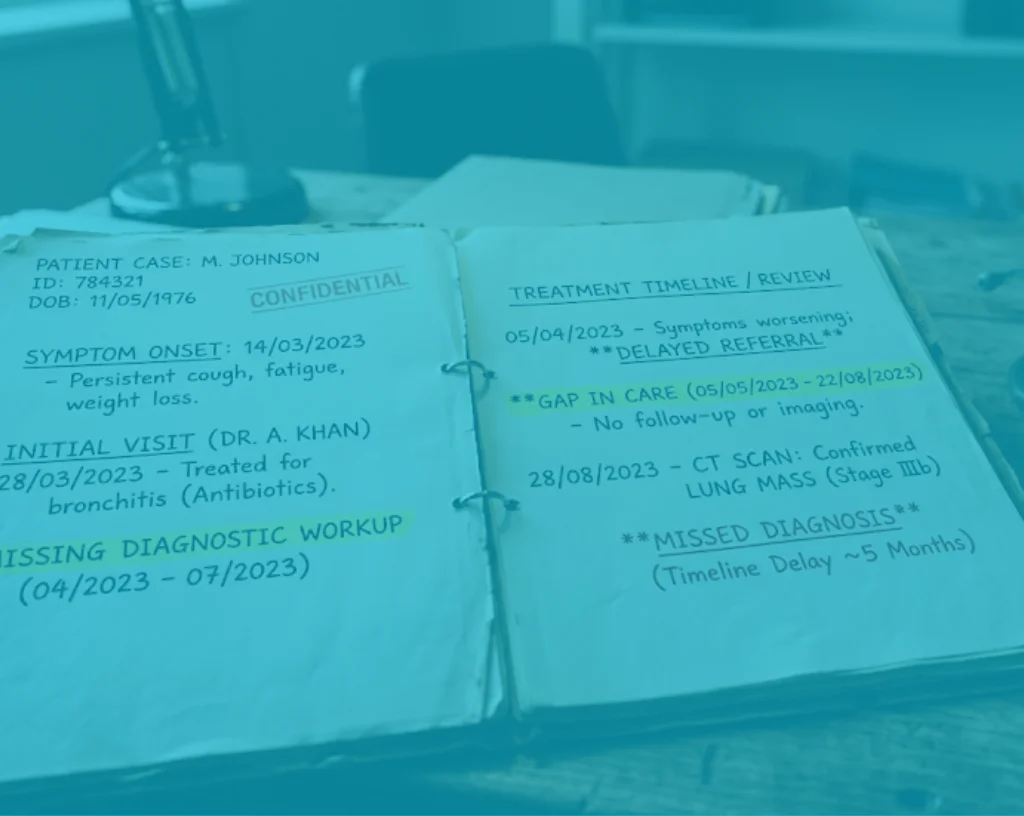
Artificial intelligence has entered legal operations with a bold promise: faster document review, quicker case analysis, better summaries, and reduced manual work. For law firms handling high-volume personal injury, mass tort, medical malpractice, or complex medical record review, that promise is especially appealing. But in many firms, AI has created a new kind of workload that does not always show up clearly on a timesheet. This hidden workload is often called AI babysitting.
AI babysitting happens when attorneys, paralegals, case managers, or support teams spend significant time checking, correcting, guiding, rechecking, and reformatting AI-generated outputs before those outputs can actually be used. On the surface, the firm appears to be using automation. In reality, the team is supervising the automation so heavily that much of the promised efficiency disappears.
The question is no longer simply whether your law firm is using AI. The more important question is whether your team is quietly managing AI in ways that look efficient but still drain time, attention, and ROI.
What Does AI Babysitting Mean?
AI babysitting is the hidden human effort required to make AI-generated work usable, accurate, and case-ready. It often begins with a simple expectation: the tool will generate a useful summary, chronology, demand draft, intake analysis, or case overview. But once the output is created, the team still has to determine whether it is complete, accurate, properly structured, and reliable enough for attorney use.
In a legal workflow, AI babysitting may include:
- Rewriting AI-generated summaries because the tone is too generic
- Checking whether key medical facts were missed
- Verifying dates, providers, diagnoses, procedures, and treatment gaps
- Correcting unsupported or unclear statements
- Comparing AI output against source records
- Re-prompting the system multiple times to get a usable result
- Asking senior staff to review work that was supposed to reduce senior staff involvement
This is not the same as responsible quality control. Every legal support workflow needs oversight, especially when medical records, damages, causation, and case strategy are involved. AI babysitting becomes a problem when the oversight itself turns into a parallel workflow. The firm thinks it has reduced manual work, but the work has simply moved from creation to correction.
What AI Babysitting Looks Like in a Legal Workflow
Consider a common medical record workflow. A law firm uploads records into an AI tool and asks for a medical chronology. The tool generates a summary quickly, which initially feels like progress. But then the internal review begins.
A paralegal checks whether all providers were included. A case manager notices that treatment gaps are not clearly identified. An attorney questions whether the injury narrative is strong enough for negotiation. Someone compares the AI summary with the original records to make sure diagnostic findings, procedures, complaints, and follow-up recommendations were not overlooked. The team then edits the output, adjusts the structure, removes unsupported language, and adds missing facts.
A workflow that was supposed to be automated can quickly become a long review cycle:
- Upload records into an AI tool
- Generate the first output
- Review the output for accuracy
- Compare the summary with source records
- Identify missing details, treatment gaps, or unsupported statements
- Re-prompt or regenerate sections
- Manually correct the chronology or summary
- Escalate uncertain findings to a senior team member
- Reformat the final version for attorney use
- Review again before sending it forward
The workflow may technically include AI, but it still depends heavily on human correction. The original goal was to reduce manual effort. Instead, the firm now has a new dependency: someone must continuously monitor whether the AI has done the work correctly. That is the core problem with AI babysitting.
Why It Looks Efficient While Draining Efficiency
AI babysitting is difficult to detect because the first step appears fast. The AI may generate something in minutes, and that speed creates the impression of efficiency. But speed at the first stage does not guarantee speed across the full workflow.
The real measure is not how quickly an AI tool produces an answer. The real measure is how quickly the firm receives a reliable, attorney-ready output that can support case strategy, settlement evaluation, demand preparation, or litigation planning. If the AI output still requires multiple review layers, the efficiency gain becomes much weaker.
This creates a misleading workflow pattern: fast generation followed by slow validation. The firm may save time at the drafting stage but lose time during verification, correction, and quality control.
In practice, the burden often shifts back to the same people the AI was supposed to support:
- Attorneys still need to check the reasoning
- Paralegals still need to compare details
- Case managers still need to identify gaps
- Senior staff still need to make judgment calls
- Teams still need to confirm whether the final output is safe to use
In other words, the work does not disappear. It becomes less visible. And because the first output arrives quickly, the hidden burden can be easy to overlook.
The Hidden ROI Strain of AI Babysitting
The ROI strain of AI babysitting is often underestimated because firms usually calculate AI savings based on generation speed, subscription cost, or reduced drafting time. But the real cost includes the human time required to make the AI output usable.
That hidden cost may include:
- Attorney review time
- Paralegal correction time
- Case manager follow-up time
- Rework from incomplete outputs
- Delays caused by unreliable summaries
- Missed medical issues or overlooked treatment gaps
- Reduced confidence in AI-generated deliverables
- Internal frustration when tools require constant supervision
For example, if an AI tool creates a medical summary in 15 minutes, that sounds efficient. But if a paralegal spends two hours checking it, an attorney spends 45 minutes correcting it, and the team still has to verify source records, the ROI calculation changes. The firm may be paying for software while still paying people to watch the software work.
That is the hidden ROI strain. It is not just a technology cost. It is an operational cost.
Is Your Law Firm Already Babysitting AI?
Your firm may already be babysitting AI if your team regularly says that the AI summary is a good start, but everything still needs to be checked. You may also see signs when staff members say the tool missed important treatment details, the format is not useful for attorneys, the output needs too much cleanup, or someone experienced still has to review every line before it can be trusted.
Common signs include:
- “The AI summary is a good start, but we need to check everything.”
- “It missed some important treatment details.”
- “We still have to compare it with the records.”
- “The format is not useful for our attorneys.”
- “It gives us something fast, but not something final.”
- “We need someone experienced to clean this up.”
- “We cannot rely on it without reviewing every line.”
These signs do not mean AI has no value. They mean AI may be sitting in the wrong role within the workflow. AI should enhance the workflow, not become another task that the team has to supervise. When a tool gives you something fast but not something final, your firm may not be saving as much time as it appears to be. The team may simply be shifting effort from preparing the work to policing the work.
Why Expert Intelligence Is the Right Choice
Trivent Legal’s Expert Intelligence approach is designed to solve this exact problem. Instead of positioning AI as the main producer of legal support outputs, Expert Intelligence begins with the foundation that matters most: medical expertise.
Trivent Legal’s medical chronologies, demand letters, and case-support deliverables are built by medical professionals who understand how to identify, organize, and present clinically relevant information for attorney use. AI enhances the experience through platform intelligence, interactive views, faster navigation, and case-file conversations, but the foundation remains expert-driven.
That distinction matters. With Expert Intelligence, the goal is not to give law firms an AI-generated draft that requires internal babysitting. The goal is to provide expert-built outputs supported by intelligent tools that help attorneys move faster, ask better questions, and make more informed decisions.
This gives law firms a stronger operational model:
- Medical experts build the foundation
- AI enhances access, speed, and usability
- Attorneys receive case-ready insights instead of raw AI output
- Internal teams spend less time correcting and more time acting
- The platform becomes a decision-support tool, not another workflow to supervise
Expert Intelligence allows technology to support the work without asking the law firm to absorb the risk and effort of constant AI supervision. Attorneys still get the benefit of speed, interactivity, and smarter access to case information, but they are not left with a raw AI output that must be rebuilt internally.
From AI Babysitting to Attorney-Ready Intelligence
The future of legal support is not about replacing expert judgment with automation. It is about combining expert-built deliverables with intelligent technology that makes those deliverables easier to use, explore, and apply.
That is the difference between AI output and Expert Intelligence. AI output may be fast, but it often needs supervision. Expert Intelligence is built to be useful from the start.
For law firms managing complex medical records, high-volume case intake, demand preparation, or litigation support, this difference can directly affect efficiency, confidence, and ROI. The real question is not whether AI can produce something quickly. The real question is whether your team can trust what it produces without spending hours babysitting it.
With Trivent Legal’s Expert Intelligence Solution, attorneys receive expert-built products with the tech edge their cases demand, helping firms reduce hidden review burdens, strengthen case preparation, and move from information overload to confident action.