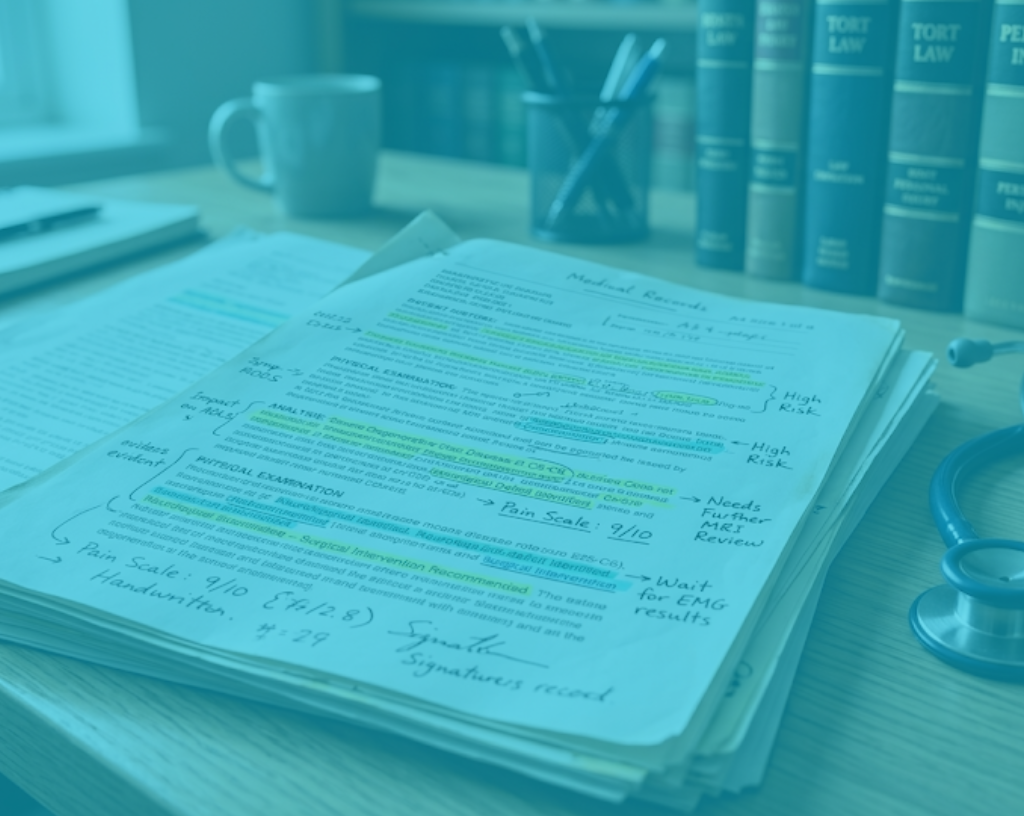
As artificial intelligence becomes more common in legal support services, many companies market “AI generated” medical chronologies, demand letters, and summaries with promises of speed and automation.
However, in high value personal injury litigation, speed alone is not enough.
Behind many AI platforms is a hidden layer of non clinical human quality assurance that simply checks formatting, grammar, or surface level consistency without providing true medical analysis. These workflows may appear efficient, but they often fail to identify the deeper clinical issues that determine case value.
High exposure cases involving spinal surgery, traumatic brain injury, chronic pain, wrongful death, or catastrophic impairment require something far more important than automated summaries.
They require genuine medical expert review.
Trivent Legal’s Expert Intelligence approach is built around medically driven analysis, where medical professionals structure, interpret, and evaluate records while AI enhances efficiency, navigation, and accessibility.
Here are seven major reasons why high value PI cases require medical expert review instead of hidden QA behind AI automation.
1. High Value Cases Require Clinical Interpretation, Not Surface Level Summaries
AI systems can organize text and identify keywords, but complex personal injury cases involve clinical reasoning that automation alone cannot provide.
Medical experts understand:
- Why treatment escalated
- Whether symptoms align with injury mechanisms
- How spinal, neurological, or orthopedic conditions progress
- Whether treatment patterns support causation
A non clinical QA reviewer checking an AI summary cannot provide this level of interpretation.
In high value cases, clinical context directly impacts settlement value.
2. Medical Experts Detect Causation Weaknesses Early
Causation is one of the most heavily contested issues in personal injury litigation.
Medical expert review helps identify:
- Delayed symptom onset
- Treatment inconsistencies
- Pre existing conditions
- Degenerative findings
- Gaps that may weaken the claim
AI automation may summarize records accurately while still missing the larger causation vulnerabilities that defense counsel will attack later.
Expert review transforms medical records into litigation strategy, not just documentation.
3. Hidden Human QA Is Not the Same as Medical Expertise
Many AI driven services rely on human QA after automated generation, but that QA is often:
- Administrative rather than clinical
- Focused on formatting and completeness
- Unable to evaluate medical significance
- Not trained to interpret injury progression
This creates a dangerous assumption that “human reviewed” means medically analyzed.
There is a major difference between:
- Reviewing whether a timeline is complete
and - Understanding whether the timeline supports causation, permanency, and damages.
High value cases require the second.
4. Medical Experts Identify Treatment Patterns That AI Alone May Miss
Complex injury cases involve subtle treatment patterns such as:
- Escalation from conservative care to surgery
- Chronic pain development
- Failed rehabilitation progression
- Long term neurological decline
- Multi provider treatment coordination
Medical experts recognize how these patterns influence:
- Injury severity
- Future medical needs
- Long term damages
- Settlement positioning
AI may identify dates and providers, but expert analysis explains why those patterns matter.
5. High Exposure Cases Require Defensible Medical Narratives
Insurance carriers and defense counsel aggressively scrutinize high value claims.
A persuasive case narrative requires:
- Clinically logical treatment progression
- Accurate symptom interpretation
- Consistent causation support
- Clear explanation of permanency and damages
Medical experts create narratives grounded in clinical understanding, not just extracted record content.
This becomes especially important in:
- Spinal surgery cases
- Traumatic brain injuries
- Mass tort litigation
- Chronic pain claims
- Wrongful death matters
6. Expert Review Reduces Risk of Critical Oversights
Automation alone can miss:
- Missing diagnostic records
- Inconsistent symptom documentation
- Conflicting provider opinions
- Critical imaging findings
- Treatment gaps that impact damages
These oversights may not become obvious until:
- Depositions
- Mediation
- Defense expert review
- Trial preparation
Medical expert review helps attorneys identify vulnerabilities before they become litigation problems.
7. High Value Litigation Requires Strategic Medical Intelligence
The goal of medical review is not simply summarization.
The goal is strategic insight.
Medical experts help attorneys:
- Understand injury progression
- Strengthen damages arguments
- Evaluate future care exposure
- Identify case risks early
- Build stronger settlement narratives
This level of strategic analysis cannot be replicated through AI generation followed by hidden non clinical QA review.
Why This Difference Matters More in High Value Cases
In lower exposure claims, simple summaries may be sufficient.
But in high value litigation involving:
- Catastrophic injuries
- Surgery
- Permanent impairment
- Long term disability
- Future medical exposure
small medical details can significantly impact settlement value.
Missing or misinterpreting those details can weaken an otherwise strong case.
The Problem With “AI + Human QA” Marketing
Many companies market workflows as:
- AI generated
- Human reviewed
- Quality checked
But rarely explain:
- Who is conducting the review
- Whether reviewers have clinical expertise
- Whether medical reasoning is involved
- Whether causation analysis is actually performed
This creates a false perception of medical depth where none may exist.
Attorneys handling high value PI litigation should ask:
- Are medical professionals actually analyzing the records?
or - Is someone simply checking AI output for formatting and completeness?
The distinction matters.
The Expert Intelligence Difference
Trivent Legal’s Expert Intelligence model is fundamentally different from hidden QA behind AI automation.
With Expert Intelligence:
- Medical professionals structure and analyze the records
- Clinical reasoning drives the review process
- AI enhances workflow efficiency and accessibility
- Attorneys receive medically meaningful litigation insights
The result is not just automation.
It is medically informed legal support designed for high exposure litigation.
Why Plaintiff Attorneys Need Medical Expert Driven Analysis
High value PI cases require:
- Defensible causation analysis
- Accurate treatment interpretation
- Clear progression timelines
- Strategic damages support
Medical expert review helps attorneys:
- Reduce litigation risk
- Strengthen negotiation leverage
- Prepare more effectively for trial
- Improve overall case quality
This level of depth cannot be replaced by hidden QA layered behind AI generated summaries.
Final Thoughts
AI has transformed legal support workflows, but automation alone is not enough for high value personal injury litigation.
Cases involving catastrophic injury, surgery, chronic pain, and long term damages require genuine medical expertise, not surface level human QA behind automated outputs.
Trivent Legal’s Expert Intelligence approach combines medical professional analysis with AI enhanced efficiency to help attorneys build stronger, more defensible cases.
Because in high value litigation, the difference between summarized records and medically intelligent analysis can directly impact case outcomes.