In modern litigation, one of the biggest bottlenecks is not lack of information, but the time required to process it. Personal injury and mass tort cases often involve thousands of pages of medical records, reports, and documentation.
Manually reviewing these records is time intensive, inconsistent, and prone to oversight.
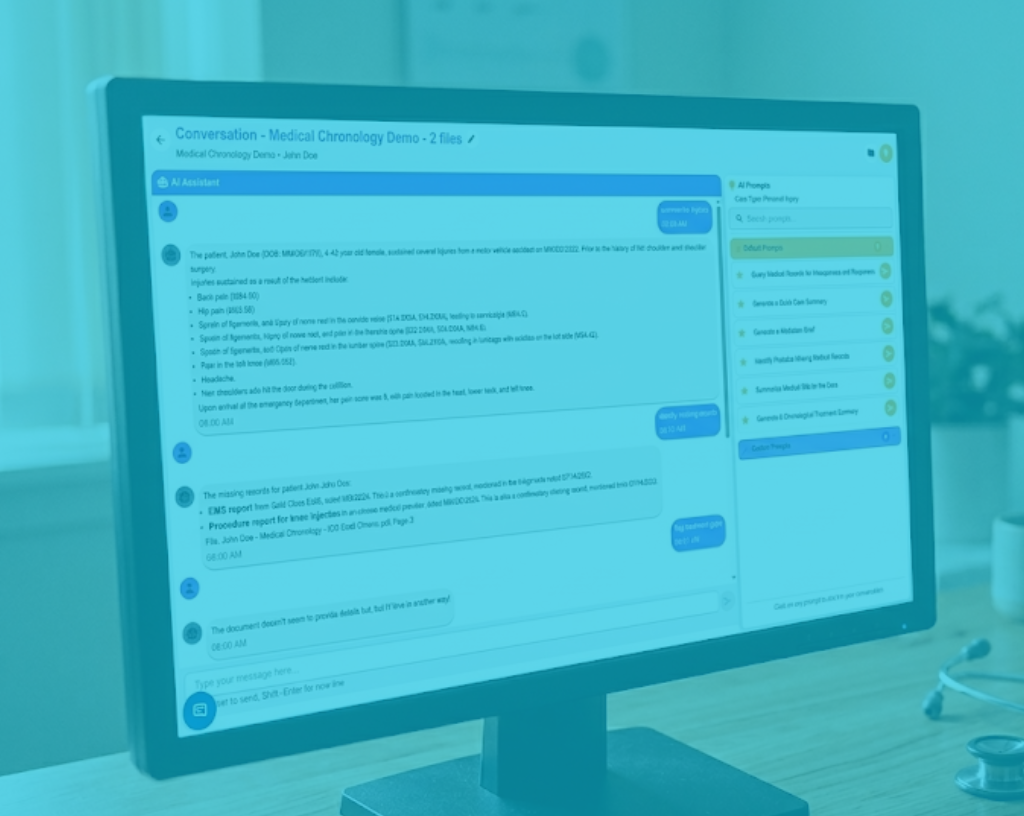
Trivent Legal’s AI Assistant within the Expert Intelligence Platform changes how attorneys interact with case data. Instead of manually searching through documents, attorneys can extract key case insights instantly through real time interaction with their case files.
This shift allows attorneys to move from document review to strategic decision making faster.
Why Manual Review Slows Down Case Strategy
Traditional case review requires attorneys or support teams to:
- Read through large volumes of medical records
- Identify relevant events manually
- Track timelines across multiple providers
- Locate key entries during deposition or negotiation
This process is not only time consuming but also increases the risk of:
- Missing critical evidence
- Delayed case preparation
- Inconsistent analysis across cases
In high volume practices, these inefficiencies compound quickly.
What the AI Assistant Does
The AI Assistant is embedded within Trivent Legal’s platform and allows attorneys to interact directly with their case data.
Instead of reviewing documents line by line, attorneys can ask targeted questions such as:
- When did symptoms first appear?
- Where are the treatment gaps?
- Which records support causation?
- What are the key risk areas in this case?
- Which entries are relevant for deposition?
The Assistant processes structured, expert built case data and returns precise, context aware answers instantly.
1. Instant Identification of Key Case Events
One of the primary advantages of the AI Assistant is its ability to surface critical case events immediately.
Attorneys can quickly identify:
- Initial diagnosis and treatment
- Key turning points in care
- Escalation of medical treatment
- Important provider observations
This eliminates the need to manually scan hundreds of pages to locate essential information.
2. Faster Causation Analysis
Causation is central to every personal injury case. The AI Assistant helps attorneys:
- Identify the timeline between incident and symptoms
- Locate supporting medical documentation
- Detect inconsistencies or conflicting entries
- Highlight relevant provider statements
By accelerating causation analysis, attorneys can prepare stronger arguments in less time.
3. Real Time Issue Spotting
Instead of discovering problems late in the case, attorneys can use the AI Assistant to identify:
- Treatment gaps
- Missing documentation
- Conflicting medical opinions
- Weaknesses in the record
Early issue detection allows attorneys to address vulnerabilities before they impact negotiations or trial.
4. Efficient Deposition Preparation
Preparing for deposition requires quick access to precise information.
With the AI Assistant, attorneys can:
- Retrieve specific dates and entries instantly
- Identify key records for questioning
- Cross reference provider statements
- Prepare targeted lines of questioning
This improves both efficiency and confidence during deposition.
5. Improved Settlement and Negotiation Readiness
During negotiations, attorneys often need immediate access to supporting documentation.
The AI Assistant enables attorneys to:
- Validate claims in real time
- Retrieve supporting evidence quickly
- Confirm treatment progression
- Respond to insurer questions without delay
This responsiveness strengthens negotiation positioning.
6. Reducing Reliance on Manual Review
Manual review is no longer the only way to understand a case.
By using the AI Assistant, attorneys can:
- Reduce hours spent reviewing records
- Minimize human error and oversight
- Standardize case analysis across teams
- Increase overall operational efficiency
This is particularly valuable for firms handling large volumes of cases.
7. Enhancing Team Collaboration
Litigation teams often involve multiple stakeholders reviewing the same case.
The AI Assistant allows:
- Faster onboarding of new team members
- Consistent understanding of case facts
- Reduced duplication of work
- Streamlined internal communication
Everyone works from the same structured insights.
From Static Documents to Interactive Case Strategy
Traditionally, reports and records are static. Attorneys must extract insights manually.
With the AI Assistant, case data becomes interactive.
Attorneys move from:
- Reading documents
to - Querying their case
This shift transforms how quickly and effectively attorneys can build strategy.
Why This Matters in High Volume Litigation
In practices handling large case inventories, time is critical.
The AI Assistant helps attorneys:
- Scale case review efficiently
- Maintain consistency across cases
- Identify key insights faster
- Reduce delays in case preparation
Efficiency at scale becomes a strategic advantage.
The Expert Intelligence Advantage
The AI Assistant operates within Trivent Legal’s Expert Intelligence framework.
This means:
- Case data is structured by medical professionals
- Insights are grounded in clinical understanding
- AI enhances accessibility and interaction
- Attorneys receive reliable, litigation ready information
This is not generic automation. It is intelligent, expert driven insight delivery.
Final Thoughts
Extracting key case insights should not require hours of manual review. Trivent Legal’s AI Assistant allows attorneys to interact with their case data in real time, uncover critical information instantly, and build stronger litigation strategies.
By transforming static documentation into an interactive experience, the platform helps attorneys save time, reduce risk, and improve case outcomes.