In personal injury litigation, understanding how an injury evolves over time is critical to building a strong case. However, tracking injury progression manually across thousands of pages of medical records is time consuming, fragmented, and often inconsistent.
Medical records are created across multiple providers, at different times, and in different formats. This makes it difficult to identify how symptoms developed, whether treatment escalated, and how the condition impacted the claimant over time.
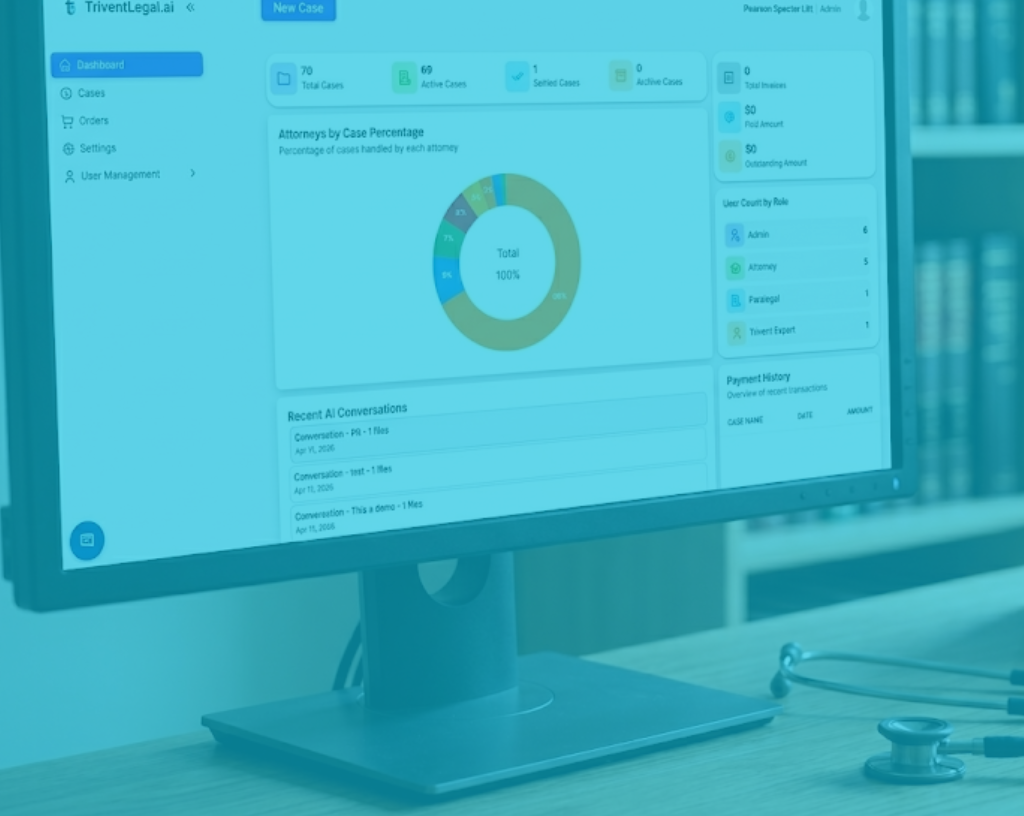
Trivent Legal’s Expert Intelligence Platform transforms this process by allowing attorneys to track injury progression in real time through structured, interactive case views. Instead of piecing together information manually, attorneys gain continuous visibility into how the injury evolves.
Why Tracking Injury Progression Is Challenging
In most cases, injury progression is not documented in a single place. Attorneys must rely on:
- Disconnected provider notes
- Scattered diagnostic reports
- Repeated manual review of medical records
- Cross referencing timelines across multiple documents
This creates several challenges:
- Delayed identification of key developments
- Missed escalation patterns
- Difficulty explaining progression clearly
- Increased risk of inconsistent case interpretation
Without a structured system, injury progression remains buried within the records.
What Real Time Injury Tracking Means
Real time injury tracking does not mean new data is constantly being created. It means attorneys can instantly access and interpret existing case data as a continuous, evolving timeline.
Within Trivent Legal’s platform, attorneys can:
- View treatment progression chronologically
- Track symptom development across providers
- Identify escalation in care as it occurs
- Monitor patterns without re reviewing documents
This transforms injury analysis from a static process into an interactive experience.
1. Visualizing Treatment Progression Clearly
The platform organizes case data into structured timelines, allowing attorneys to see:
- Initial diagnosis and early symptoms
- Follow up visits and provider interactions
- Changes in treatment approach
- Escalation from conservative care to advanced intervention
This clear visualization helps attorneys understand how the injury evolved without manually reconstructing the timeline.
2. Identifying Escalation in Real Time
One of the most important indicators of injury severity is treatment escalation.
With real time tracking, attorneys can quickly identify:
- Transition from primary care to specialist involvement
- Increased frequency of medical visits
- Introduction of advanced procedures or interventions
- Movement toward surgical or long term care
These insights strengthen both causation and damages arguments.
3. Monitoring Symptom Consistency Across Providers
Injury progression is often validated through consistent symptom reporting.
The platform allows attorneys to:
- Track repeated symptom complaints
- Compare provider observations
- Identify continuity in medical documentation
- Detect variations or inconsistencies early
This helps build a stronger and more credible medical narrative.
4. Detecting Treatment Gaps Instantly
Treatment gaps can significantly impact case strategy if not identified early.
Using structured timeline views, attorneys can:
- Spot gaps between visits immediately
- Evaluate whether gaps affect causation
- Prepare explanations before defense raises them
This proactive visibility prevents surprises during negotiation or deposition.
5. Connecting Injury Progression to Damages
Real time tracking allows attorneys to directly connect medical progression to damages.
They can:
- Correlate escalation with increased medical costs
- Link persistent symptoms to long term impact
- Demonstrate chronic condition development
- Support future care expectations
This strengthens both economic and non economic damages arguments.
6. Improving Deposition and Trial Preparation
Tracking injury progression in real time enhances litigation preparation.
Attorneys can:
- Retrieve key timeline events instantly
- Identify critical turning points in treatment
- Prepare structured testimony narratives
- Present a clear progression story to juries
This improves clarity and confidence during litigation.
7. Eliminating Repetitive Manual Review
One of the biggest advantages of the platform is reducing the need for repeated document review.
Instead of:
- Re reading records for each stage of the case
- Manually updating timelines
- Searching for key events repeatedly
Attorneys can rely on a continuously accessible, structured view of the case.
This improves efficiency and reduces the risk of oversight.
From Static Records to Continuous Case Visibility
Traditionally, injury progression is reconstructed after the fact.
With Trivent Legal’s platform, attorneys gain:
- Immediate access to structured case timelines
- Continuous visibility into treatment progression
- Faster identification of critical developments
- A clearer understanding of how the injury evolved
This shift allows attorneys to stay ahead of the case instead of reacting to it.
Why This Matters in High Volume Litigation
For firms handling multiple cases, tracking progression manually is not scalable.
The platform enables attorneys to:
- Monitor multiple cases efficiently
- Maintain consistency in case analysis
- Identify key developments faster
- Reduce delays in case preparation
This creates a significant operational advantage.
The Expert Intelligence Advantage
Trivent Legal’s platform is built on Expert Intelligence, ensuring that:
- Medical data is structured by medical professionals
- Injury progression is clinically meaningful
- Insights are accurate and litigation ready
- Technology enhances accessibility without replacing expertise
This combination ensures attorneys receive reliable, actionable insights.
Final Thoughts
Tracking injury progression is essential for proving causation, demonstrating severity, and supporting damages. However, manual review limits speed, accuracy, and efficiency.
Trivent Legal’s Expert Intelligence Platform allows attorneys to track injury progression in real time, transforming complex medical records into a clear, continuous narrative.
By moving from static documents to interactive case visibility, attorneys can build stronger strategies, respond faster, and improve overall case outcomes.