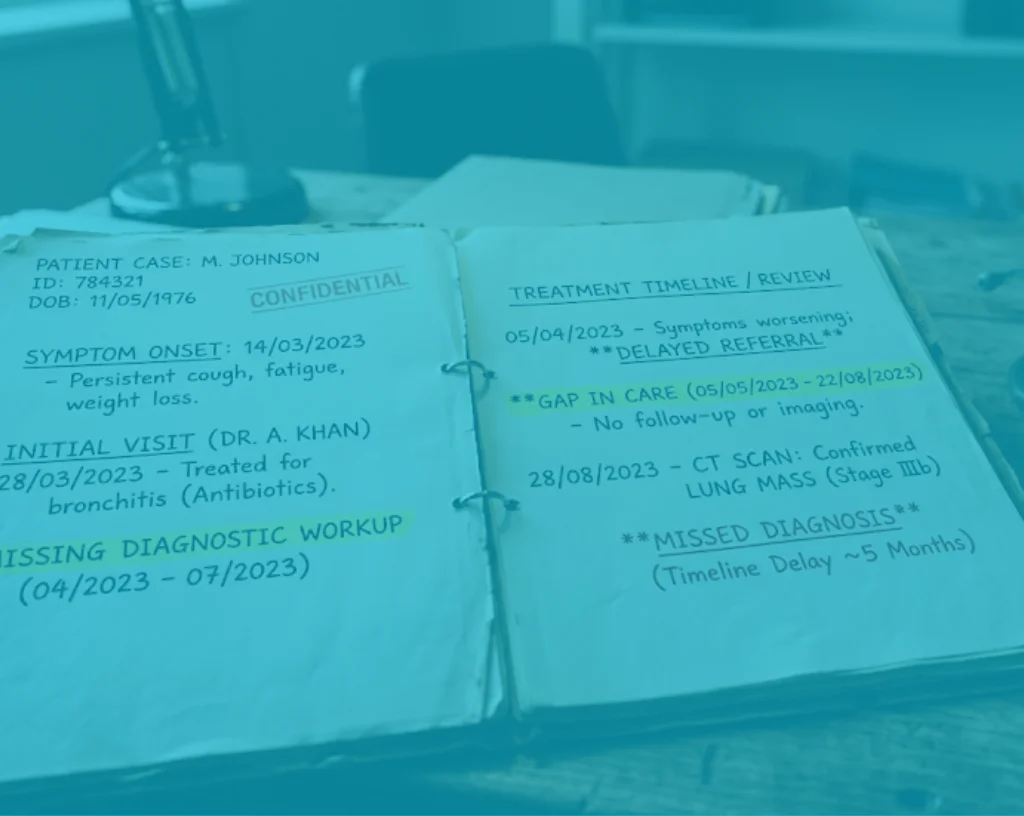
Introduction
In medical malpractice and delayed diagnosis cases, establishing that a diagnosis occurred later than it should have is only part of the analysis. A timeline may show when symptoms were reported, when providers evaluated the patient, and when the eventual diagnosis was made. However, the timeline alone does not explain the most important question:
What did the delay mean medically?
For attorneys, proving that a diagnosis was delayed is rarely enough. They must understand how the delay affected treatment options, disease progression, patient outcomes, and overall damages. This requires more than chronology review. It requires medical interpretation.
That is why medical opinion support plays a critical role in delayed diagnosis litigation. While timelines help establish when events occurred, medical review helps attorneys understand why those events matter and whether the delay had meaningful clinical consequences.
Why Delayed Diagnosis Cases Are More Complex Than Timeline Reviews
At first glance, delayed diagnosis cases appear to revolve around dates.
Attorneys often begin by examining:
- Initial symptom presentation
- Provider evaluations
- Diagnostic testing
- Follow-up appointments
- Specialist referrals
- Final diagnosis
The objective is to determine whether there was a gap between when a condition could have been identified and when it was actually diagnosed.
However, even when that gap is identified, additional questions remain:
- Would earlier diagnosis have changed treatment?
- Did the condition worsen during the delay?
- Were additional complications created?
- Did the patient lose treatment opportunities?
- Did prognosis change because of the delay?
These questions require medical analysis rather than timeline review alone.
The Difference Between a Timeline and a Medical Opinion
A medical chronology helps attorneys understand the sequence of events.
For example, a chronology may show:
- Symptoms reported in January
- Follow-up visits in February
- Diagnostic imaging in April
- Specialist referral in May
- Diagnosis in June
The chronology answers:
What happened and when?
A medical opinion helps answer:
Why does it matter?
The medical review may evaluate:
- Whether symptoms warranted earlier investigation
- Whether diagnostic findings were overlooked
- Whether delays affected treatment decisions
- Whether disease progression occurred during the delay
- Whether patient outcomes were affected
Both components are important, but they serve different purposes.
Common Delayed Diagnosis Scenarios Attorneys Encounter
Delayed diagnosis litigation spans a wide range of medical conditions.
Examples frequently include:
Cancer Diagnosis Delays
Questions often focus on:
- Whether earlier detection was possible
- Whether staging changed during the delay
- Whether treatment options became limited
Stroke and Neurological Conditions
Review may involve:
- Symptom recognition
- Diagnostic response timelines
- Treatment window considerations
Orthopedic Injuries
Attorneys may evaluate:
- Missed fractures
- Delayed surgical referrals
- Progressive injury complications
Infectious Diseases
Key issues often include:
- Delayed treatment initiation
- Disease progression
- Additional complications
Cardiac Conditions
Reviews may assess:
- Missed warning signs
- Delayed interventions
- Impact on patient outcomes
In each scenario, understanding the medical significance of the delay is critical.
Why Medical Records Review Alone May Not Answer Key Questions
A thorough medical records review provides valuable information about treatment history, provider documentation, and diagnostic findings.
However, records alone do not always explain:
- Whether provider decisions were medically appropriate
- Whether symptoms should have triggered further investigation
- Whether a delay changed clinical outcomes
- Whether the condition progressed during the relevant period
Attorneys may identify a gap between symptoms and diagnosis but still lack insight into whether the delay created meaningful harm.
This is where medical opinion support becomes valuable.
The goal is not simply identifying a delay.
The goal is understanding its significance.
How Medical Chronologies Support Delayed Diagnosis Reviews
A medical chronology remains an important part of the review process because it establishes the factual timeline.
Chronologies help attorneys identify:
- Symptom onset
- Provider interactions
- Diagnostic testing dates
- Referral timelines
- Treatment milestones
- Diagnosis dates
When organized effectively, chronologies make it easier to spot potential gaps and areas requiring further review.
However, chronologies are most valuable when paired with medical analysis that explains the implications of those events.
The chronology establishes the sequence.
The medical opinion helps explain the significance.
Why Medical Context Matters More Than Dates Alone
Many delayed diagnosis cases involve lengthy medical records and multiple providers.
Technology can help attorneys:
- Search records faster
- Locate diagnostic findings
- Navigate documentation more efficiently
However, efficient record access does not automatically provide clinical insight.
Attorneys still need answers to questions such as:
- Was the condition reasonably identifiable earlier?
- Did symptoms support additional evaluation?
- Did the delay impact treatment options?
- Was patient harm increased because of the delay?
These questions require medical context.
The objective is not simply determining when events occurred. The objective is understanding how those events affected the patient’s medical outcome.
What Attorneys Should Look for During Delayed Diagnosis Reviews
When evaluating delayed diagnosis cases, attorneys should focus on several key areas.
Symptom Documentation
Were symptoms consistently documented before diagnosis?
Diagnostic Opportunities
Were there opportunities for earlier testing or evaluation?
Provider Decision-Making
How did providers respond to reported symptoms?
Disease Progression
Did the condition worsen during the delay period?
Treatment Impact
Would earlier diagnosis have altered available treatment options?
Patient Outcome Changes
Did prognosis or recovery potential change because of the delay?
These factors often determine the strength and value of the case.
How Trivent Legal Helps
Trivent Legal helps plaintiff firms organize complex delayed diagnosis cases through its Expert Intelligence Solution.
Support includes:
- Medical records review
- Medical chronologies
- Medical record summaries
- Medical opinions
- Missing records identification
- Treatment timeline organization
Medical experts review treatment history, diagnostic timelines, symptom progression, and clinically significant events to help attorneys better understand the medical context behind delayed diagnosis claims.
AI-powered platform capabilities then improve usability, navigation, and information access, helping legal teams interact with complex medical documentation more efficiently.
This combination helps attorneys move beyond timelines and better understand the medical significance of delayed diagnoses.
Conclusion
Delayed diagnosis cases involve more than identifying a gap between symptoms and diagnosis.
While timelines are essential for establishing what happened and when, they do not always explain whether the delay affected patient outcomes, treatment options, or disease progression.
For attorneys evaluating these cases, understanding the medical significance behind the delay is often the most important part of the analysis.
By combining medical chronologies, records review, and medical opinion support, firms can develop a clearer understanding of how delayed diagnoses may have impacted patient care and case value.
Frequently Asked Questions
A delayed diagnosis review examines medical records, treatment history, diagnostic timelines, and provider actions to determine whether a condition was diagnosed later than it reasonably should have been.
A medical opinion helps attorneys understand whether the delay affected treatment options, disease progression, patient outcomes, or overall damages.
A medical chronology organizes symptoms, provider visits, diagnostic testing, referrals, and diagnosis dates into a structured timeline that supports case evaluation.
Medical records provide important factual information, but attorneys often need medical interpretation to understand the significance of provider decisions and patient outcomes.
Common examples include cancer, stroke, neurological disorders, cardiac conditions, infections, fractures, and other medical conditions where earlier diagnosis may have changed treatment or outcomes.