Introduction
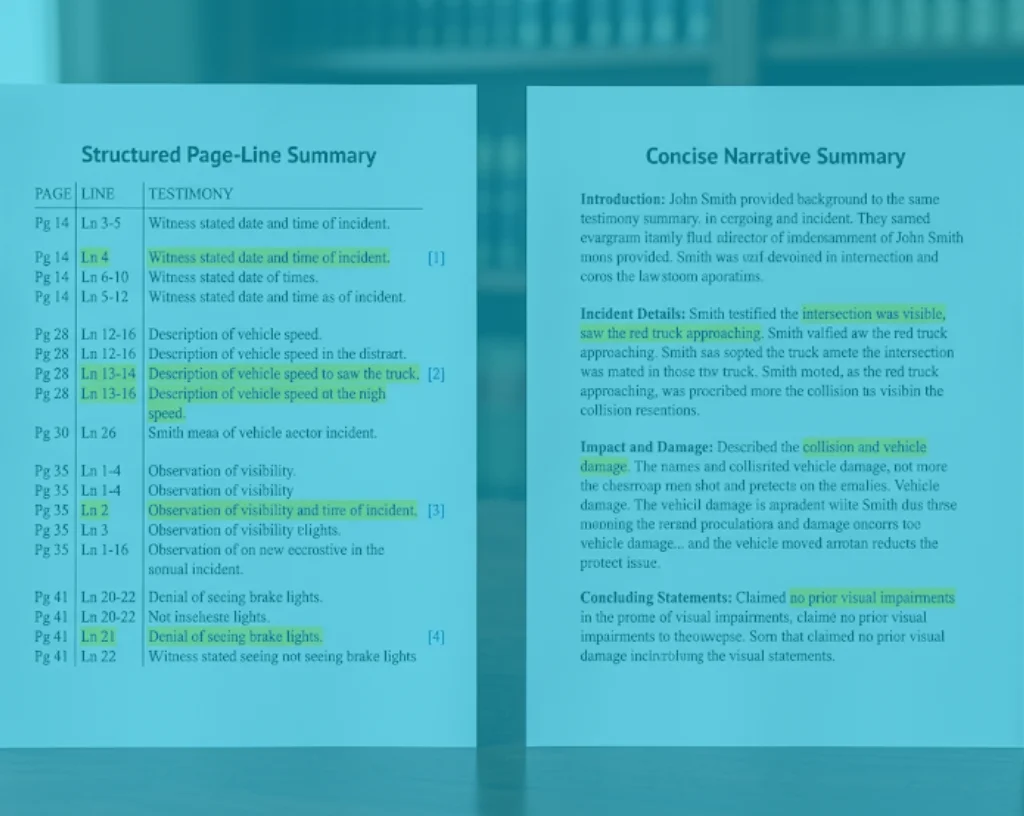
Not every deposition summary should look the same. Some transcripts need precise page-line references for cross-examination, impeachment, or motion support. Others need a readable narrative that helps the team understand themes.
This is where page line vs narrative deposition summary becomes practical for plaintiff firms. The issue is not simply producing another document. It is giving attorneys, paralegals, case managers, and medical review teams a clearer way to understand the file, identify gaps, and move the matter toward the next stage of preparation.
Why This Topic Matters for Plaintiff Firms
Deposition summaries help firms manage transcript volume, but the format determines how useful the summary will be for attorneys, paralegals, case managers, experts, and settlement teams.
For high-volume PI, medical malpractice, and mass tort teams, the value is operational as much as legal-supportive: less time spent hunting for facts, fewer inconsistent summaries, and more repeatable documentation across attorney teams.
- Improves attorney review time
- Supports demand, mediation, or expert-preparation readiness
- Creates more consistent internal documentation
- Helps identify missing records or unclear facts earlier
- Supports scalable workflows across recurring case volume
The Workflow Bottleneck
Firms often select a summary format without considering how the transcript will be used.
For many firms, the bottleneck shows up in several practical ways:
- Whether exact citations are needed
- Whether the team needs a readable overview
- Whether the transcript will support cross-examination
- Whether expert preparation depends on specific testimony
- Whether the testimony involves medical causation or damages
- Whether the summary will be used for mediation or trial preparation
Need the right deposition summary format?
Which AI Deposition Summary Format Fits Each Litigation Task?
Attorneys searching for page line vs narrative deposition summary may encounter software-only tools or generic service directories. But the underlying litigation decision requires medically grounded analysis, reliable documentation, and case-specific judgment. Trivent Legal’s Expert Intelligence approach combines medical experts, structured workflows, and AI-powered usability so attorney teams can act on clearer case information.
Trivent Legal’s Expert Intelligence Solution combines expert-built medical documentation with AI-powered platform usability. Medical experts build the documentation foundation, while AI enhances attorney usability, speed, interactivity, and insight. The result is a workflow that keeps medical judgment and litigation context at the center while making the information easier for attorney teams to use.
What Attorneys Should Look For
Attorney teams should evaluate whether the documentation answers the questions that matter for the next case milestone. A practical review should include:
- Whether exact citations are needed
- Whether the team needs a readable overview
- Whether the transcript will support cross-examination
- Whether expert preparation depends on specific testimony
- Whether the testimony involves medical causation or damages
- Whether the summary will be used for mediation or trial preparation
How Trivent Legal Helps
Trivent Legal supports this workflow through services that fit the case need, including Page-line deposition summaries, Narrative deposition summaries, Deposition transcript review, Witness testimony analysis, and Medical documentation support.
This support helps attorneys see the case story more clearly, identify gaps earlier, and work from a stronger medical foundation. It also supports more consistent review across attorney teams when firms are handling recurring volume.
The goal is not to promise a legal outcome or replace attorney judgment. The goal is to reduce documentation pressure, improve medical clarity, and create attorney-usable work product that fits the litigation workflow.
Practical Takeaway
What Is the Difference Between a Page-Line Summary and a Narrative Deposition Summary starts with organized information. When the medical records, testimony, bills, or claimant details are clear, attorney teams can make better use of their time and move the file forward with more confidence.
For high-volume plaintiff workflows, Trivent Legal’s Expert Intelligence Solution supports scalable documentation by combining expert-built medical work product with AI-powered usability.