Overview
A Texas-based mid-size plaintiff personal injury law firm handling a traumatic brain injury claim needed more than a basic summary of treatment events. The medical record set was lengthy, fragmented, and difficult to review in a linear way. Emergency care, primary care visits, imaging references, therapy notes, specialist referrals, and symptom reports appeared across different providers, but the attorney team did not yet have a clear view of whether the neurological documentation was complete.
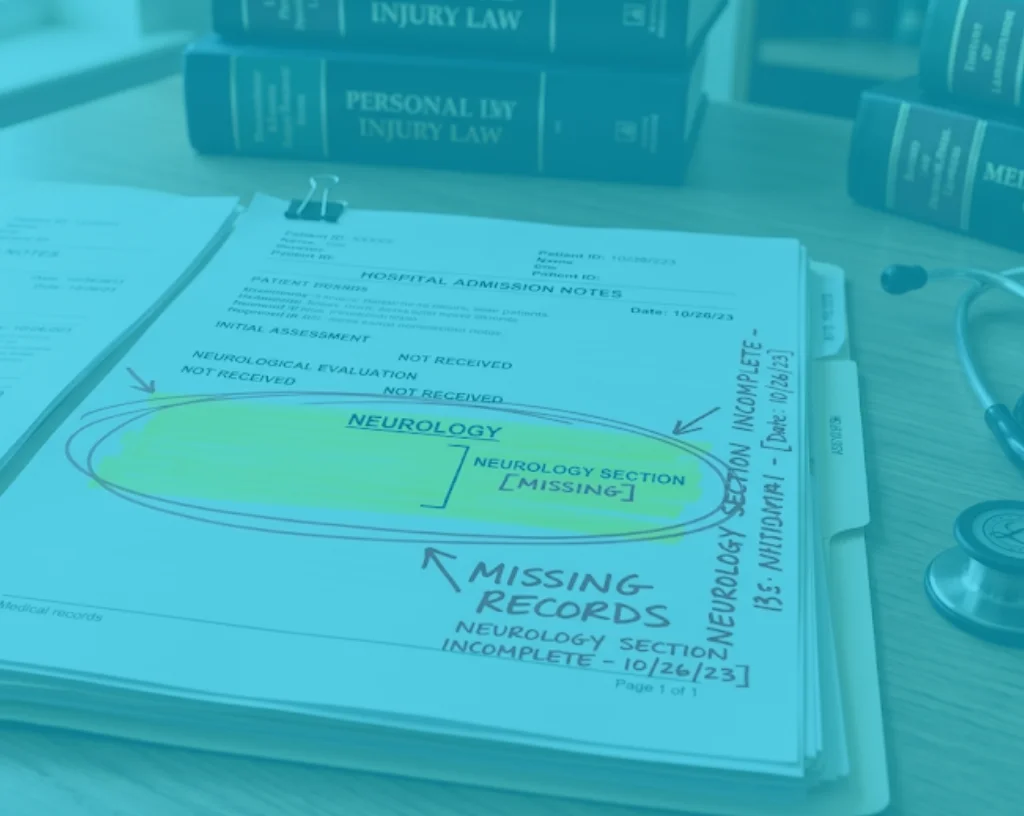
For a TBI claim, missing neurology records can create real workflow pressure. The issue is not simply volume. It is whether the team can see the full treatment progression, understand when symptoms were reported, identify which providers were involved, and determine whether additional records may be needed before further case evaluation.
Trivent Legal supported the firm through expert-built medical records review, medical record summaries, missing records identification, and treatment timeline organization. The result was a clearer medical foundation that helped the attorney team review the claim with better structure and less internal uncertainty.
The Workflow Challenge
The firm had records, but the injury picture was still incomplete. The attorney team was reviewing a TBI claim with neurological symptoms referenced in different parts of the file, yet the available records did not fully connect those references to specialist evaluation.
That created several practical problems:
- Important symptom details were buried across long records.
- Neurology-related references were not easy to track.
- The team needed better visibility into whether records were missing.
- The treatment timeline was difficult to follow across providers.
- Attorney review time was being spent locating facts instead of working from an organized medical foundation.
In this type of file, a quick summary is rarely enough. TBI claims often involve evolving symptoms, delayed specialist referrals, inconsistent terminology, and overlapping treatment records. The attorney team needed a review process that could organize what was present while also flagging what appeared absent.
Why This Mattered for the Attorney Team
The internal burden was not only that the records were long. It was that the records did not answer the team’s practical review questions in a clear sequence.
When did neurological symptoms first appear? Which providers documented them? Was neurology actually consulted? Were the relevant follow-up records included? Did the treatment timeline show progression, gaps, or unresolved documentation needs?
Without that structure, attorney teams can spend too much time moving back and forth between PDFs, provider portals, intake notes, and internal case comments. That slows review and increases the chance that different team members form different impressions of the same medical history.
For a busy PI team, medical records review needs to support consistency. The review should help the team understand the treatment progression, locate key facts faster, and see whether the file is ready for the next internal step or still needs additional documentation.
Trivent Legal’s Expert Intelligence Approach
Trivent Legal approached the file through its Expert Intelligence Solution, which combines expert-built medical documentation with AI-powered platform usability. The medical foundation was built by experts who understood how to review dense injury records, organize treatment progression, and identify documentation gaps. AI-powered usability then supported easier access, search, interaction, and insight for the attorney team.
This mattered because firms evaluating AI medical record review for attorneys still need medically grounded documentation. TBI records are not just a pile of dates and diagnoses. They require careful organization around symptom progression, provider involvement, diagnostic references, and missing-record visibility.
Trivent Legal’s work focused on:
- Reviewing the available medical records for TBI-related treatment details.
- Organizing the treatment sequence into a clearer timeline.
- Summarizing key medical events in attorney-usable language.
- Identifying references to neurology evaluation or follow-up.
- Flagging apparent missing neurology documentation for further record collection.
- Creating a more usable medical record summary for internal review.
The goal was not to replace the attorney team’s judgment. It was to give the team a clearer, more consistent medical foundation so they could review the claim with less friction.
What Improved
After Trivent Legal’s review, the attorney team had better visibility into the medical record set and the documentation gaps affecting the claim.
The most useful improvement was clarity. Instead of searching repeatedly across disconnected records, the team could work from a more organized view of the treatment progression. Neurological symptoms, related provider notes, and potential missing records were easier to see in context.
The firm also gained a stronger workflow for internal review. The medical record summary and treatment timeline gave the attorney team a more consistent reference point, reducing the need for repeated fact-finding across the same file.
Proof-safe improvements included:
- Clearer understanding of TBI-related treatment progression.
- Better visibility into missing neurology records.
- Reduced time spent searching through scattered medical records.
- More consistent internal review of the medical facts.
- Improved case organization for further evaluation.
The value was practical: the team could see what was in the file, what appeared to be missing, and how the treatment history developed over time.
Takeaway for Similar Firms
TBI claims often create review pressure because the most important medical facts are not always found in one place. Neurological symptoms may appear across emergency records, therapy notes, primary care visits, imaging references, and specialist referrals. Without expert-built organization, attorney teams can spend too much time reconstructing the record set themselves.
Trivent Legal helps personal injury firms turn complex medical records into clearer summaries, chronologies, and missing-record insights. Its Expert Intelligence Solution gives firms the benefit of expert-built medical documentation supported by AI-powered platform usability, helping teams manage dense records with greater confidence and consistency.
Handling TBI claims with incomplete or scattered medical records? Schedule a one-on-one call to see how Trivent Legal can support expert-built medical records review.