Overview
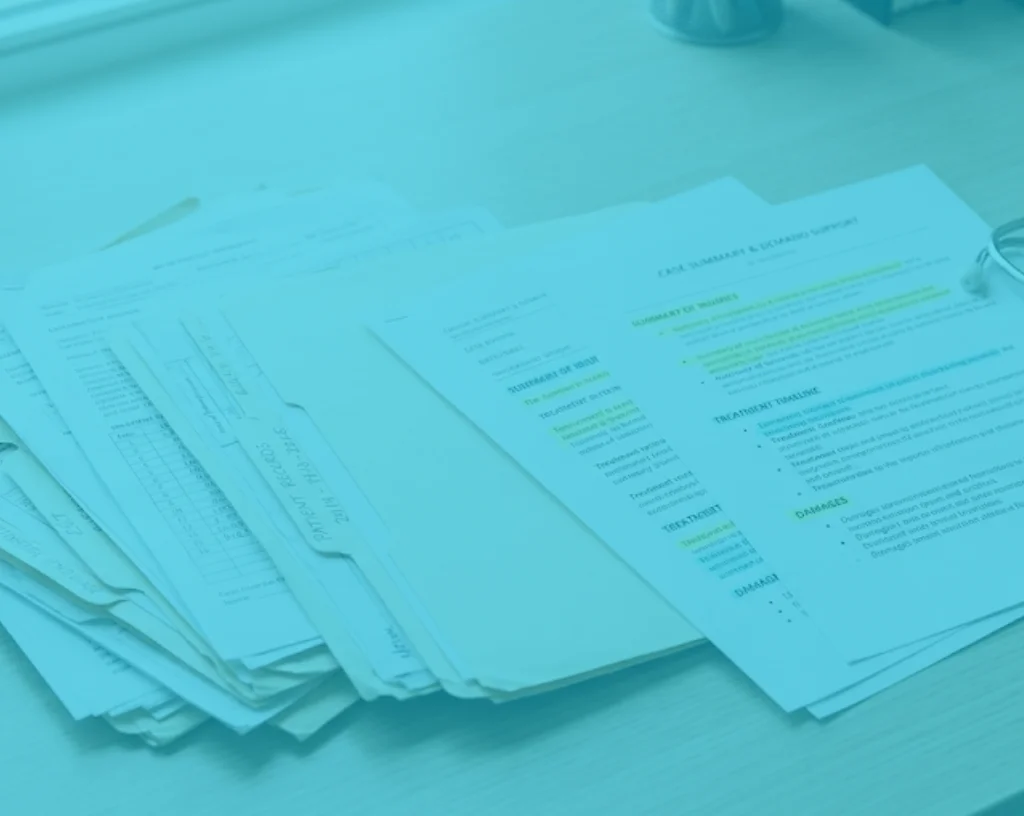
A Boston based high-volume personal injury firm handling complex injury matters had no shortage of medical records. The problem was that those records were spread across providers, visits, imaging reports, specialist notes, and treatment updates without a clear medical story the attorney team could use during demand preparation.
The firm’s internal team was moving cases forward, but attorneys were spending too much time reconstructing treatment progression from source records. For a PI team managing recurring case volume, that created pressure at exactly the point where the medical facts needed to become organized, concise, and demand-ready.
Trivent Legal supported the firm by turning scattered records into structured medical record summaries built for attorney usability. The goal was not to replace legal judgment or automate the demand process. It was to give the team a stronger medical foundation before drafting began.
The Workflow Challenge
The firm had records, but the records were not yet usable in the way the attorney team needed. Treatment details were available somewhere in the file, but key facts were buried across long PDFs, provider packets, and inconsistent document sets.
That made demand preparation slower than it needed to be. Before attorneys could focus on the demand narrative, they first had to confirm treatment dates, identify providers, understand injury progression, and locate support for important medical facts.
The firm’s internal team was dealing with several recurring issues:
- Medical records were spread across multiple providers and record sets
- Treatment progression was difficult to follow from beginning to end
- Attorneys had to spend extra time locating key facts before demand review
- Internal notes and summaries varied across cases
- Questions about missing or incomplete records surfaced late in the process
- Demand preparation was slowed by unclear medical organization
The bottleneck was not simply volume. It was the lack of a consistent, medically grounded summary format that could help the attorney team move from raw records to organized case facts.
Why This Mattered for the Attorney Team
For a busy PI firm, scattered records create more than administrative friction. They affect how much attorney time is spent on record navigation instead of case evaluation, client communication, demand review, and next-step preparation.
When every case requires attorneys to rebuild the treatment timeline from scratch, the workflow becomes harder to scale. Paralegals and case managers may gather records efficiently, but if the medical story is still unclear, attorneys still carry the burden of interpretation and organization.
The issue also affected team consistency. Different attorneys and staff members could pull different details from the same record set, not because anyone was careless, but because the source material was dense and the review process was not standardized. That created more back-and-forth before the demand package could move forward.
For firms managing complex injury files, demand readiness depends on more than having the records in hand. Attorneys need a clear view of diagnoses, treatment progression, provider involvement, gaps in care, imaging findings, specialist referrals, and unresolved documentation issues. Without that structure, medical record review becomes a repeated internal lift rather than a reliable part of the case workflow.
Trivent Legal’s Expert Intelligence Approach
Trivent Legal supported the firm with expert-built medical documentation designed to make the records easier to review and use. The work focused on medical record summaries that organized the treatment story before demand drafting began.
Trivent Legal’s Expert Intelligence Solution combines expert-built medical documentation with AI-powered platform usability. Medical experts build the documentation foundation, while AI enhances attorney usability, speed, interactivity, and insight. In this case, that meant the firm received summaries that reflected medical context and treatment progression, supported by a workflow that made case information easier to access and review.
As more PI firms evaluate AI tools for demand preparation or medical records review, the practical need remains the same: attorneys need medically grounded documentation they can trust. A demand letter workflow is stronger when the medical story is organized first, with technology supporting usability rather than standing in for medical review.
Trivent Legal supported the firm with:
- Expert-built medical record summaries
- Treatment progression organization
- Key provider, diagnosis, and treatment detail review
- Identification of potential missing record issues
- A consistent format for attorney-team review
- A stronger medical foundation for demand preparation
The summaries helped the attorney team see the case more clearly before drafting. Instead of moving directly from raw records to a demand letter, the firm had an organized medical layer that made the next step more efficient and consistent.
What Improved
With a more structured review workflow, the firm gained a clearer path from record collection to demand preparation. The improvement was not framed around case outcomes. It was a workflow improvement: better organization, stronger visibility, and less internal friction around medical facts.
The firm gained:
- Clearer treatment progression across complex injury files
- More usable medical record summaries for attorney review
- Reduced back-and-forth between attorneys and internal staff
- Better visibility into missing or incomplete record issues
- A stronger medical foundation before demand drafting
- More consistent summary outputs across similar PI cases
- Less pressure on attorneys to rebuild the medical story from source records
This gave the team a more reliable way to move from scattered records to demand-ready medical summaries. Attorneys still made the legal decisions, but they were no longer starting from an unorganized record set.
Takeaway for Similar Firms
High-volume and complex injury PI firms often have strong intake and record collection processes, yet still feel the pressure when medical records need to become usable for demand review. The gap usually appears between “we have the records” and “we understand the treatment story well enough to draft.”
Trivent Legal helps close that gap with expert-built medical documentation supported by AI-powered platform usability. For firms handling recurring case volume, that combination can support a more scalable documentation workflow without treating medical review as a fully automated task.
Need demand-ready medical summaries before drafting? Schedule a one-on-one call to see how Trivent Legal can support your demand preparation workflow.