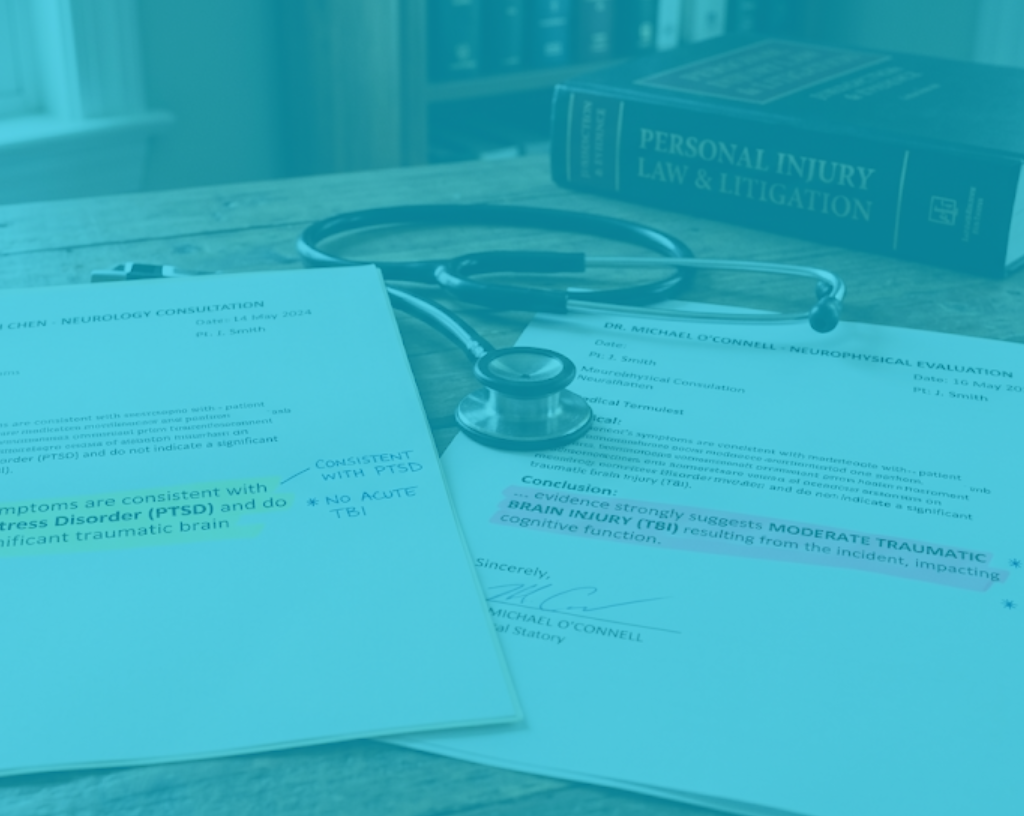
In complex personal injury and medical negligence cases, it is not uncommon for multiple specialists to produce conflicting medical opinions. An orthopedic surgeon may recommend surgery while a neurologist questions structural causation. A pain management specialist may document chronic impairment while another provider attributes symptoms to degeneration. When expert opinions diverge, attorneys face a strategic challenge.
Conflicting reports can weaken causation arguments, reduce settlement leverage, and create uncertainty in litigation preparation. This case study demonstrates how Trivent Legal’s specialized medical opinion helped plaintiff’s counsel reconcile conflicting specialist findings, clarify the medical narrative, and strengthen the overall litigation strategy.
Background
The case involved an adult plaintiff who sustained injuries following a negligence related incident. The injury primarily involved the cervical and lumbar spine, with complaints of radiating pain, numbness, and functional limitation.
Over the course of treatment, the plaintiff was evaluated by multiple specialists, including:
- An orthopedic surgeon
- A neurologist
- A pain management physician
- A physical medicine and rehabilitation specialist
While each provider documented elements of the injury, their interpretations varied.
Some key differences included:
- Disagreement over whether imaging findings were acute or degenerative
- Divergent views on the necessity of surgical intervention
- Conflicting descriptions of radiculopathy
- Inconsistent apportionment between pre existing conditions and new injury
Defense counsel capitalized on these inconsistencies, arguing that the plaintiff’s condition was unclear and medically disputed.
Plaintiff’s counsel engaged Trivent Legal to provide a specialized, independent medical opinion that could reconcile the record.
Attorney Challenge
The legal team faced several strategic risks:
- Conflicting reports could undermine credibility before mediation.
- Defense experts could highlight inconsistencies during deposition.
- Causation arguments required a unified medical explanation.
- Imaging findings needed contextual clinical interpretation.
- Apportionment required clear reasoning rather than assumption.
The attorney required a physician-authored opinion that would objectively evaluate all reports and clarify areas of disagreement.
Trivent Legal’s Expert Intelligence Approach
1. Comprehensive Record Integration
Trivent Legal’s clinical analysts first consolidated:
- All specialist consultation reports
- Diagnostic imaging studies
- Surgical recommendations
- Therapy progress notes
- Pain management documentation
This created a unified dataset for physician review.
2. Identification of Points of Conflict
Before issuing an opinion, the reviewing MD identified:
- Direct contradictions in interpretation
- Variations in terminology
- Differences in causation analysis
- Disparities in recommended treatment pathways
Each area of disagreement was clearly mapped.
3. Physician Authored Reconciliation Analysis
The Trivent Legal MD provided a structured medical opinion that:
- Addressed each specialist’s findings individually
- Explained where interpretations aligned
- Clarified where disagreement stemmed from perspective rather than contradiction
- Distinguished imaging degeneration from symptomatic injury
- Evaluated whether trauma exacerbated pre existing findings
- Rather than choosing sides, the opinion synthesized the medical data into a clinically coherent narrative.
4. Clarifying Causation and Apportionment
The medical opinion specifically addressed:
- Whether the plaintiff’s symptoms were temporally consistent with the incident
- Whether objective findings supported radiculopathy
- Whether surgical recommendations were medically reasonable
- Whether pre existing degeneration was symptomatic prior to the event
- The extent to which the incident contributed to current impairment
This clarification reduced ambiguity in the record.
Key Findings
The MD medical opinion concluded that:
- Imaging findings were consistent with trauma related exacerbation.
- Pre existing degeneration did not fully explain post incident symptoms.
- Radicular complaints were supported by documented clinical findings.
- Treatment recommendations were medically reasonable given the progression.
- The conflicting reports could be reconciled when viewed in chronological context.
These findings restored coherence to the case.
Litigation Value Delivered
The specialized medical opinion provided significant strategic advantages.
Unified Medical Narrative
The attorney now had a single, structured document explaining how all specialist opinions fit within the broader clinical picture.
Improved Deposition Strategy
Conflicting language was clarified before cross examination could exploit it.
Strengthened Causation Argument
The opinion linked objective findings to the incident in a medically reasoned manner.
Reduced Defense Leverage
The defense could no longer rely solely on internal inconsistencies.
Enhanced Settlement Position
Negotiations shifted from disagreement about medical confusion to discussion of documented impairment.
Outcome
With the reconciled medical opinion in place, plaintiff’s counsel was able to confidently address conflicting reports during mediation. The structured analysis prevented fragmentation of the case theory and preserved the integrity of the damages claim.
The attorney reported that the opinion became a central reference point for expert consultation and strategic planning.
Conclusion
Conflicting specialist reports can derail otherwise strong cases. Without clarification, inconsistencies create vulnerability in causation and damages arguments. This case illustrates how Trivent Legal’s specialized medical opinion brings structure and clinical coherence to complex medical records.
By synthesizing divergent opinions into a unified, medically reasoned narrative, Trivent Legal empowers attorneys to move forward with clarity and confidence. When medical disagreement threatens strategy, structured expert analysis restores control.