Introduction
In premises liability cases, proving negligence is only one part of the equation. Even when liability is clear, the strength of a case often depends on how effectively medical evidence is connected to the incident. Without this alignment, injuries may appear disconnected from the event, allowing defense counsel to question causation or minimize damages.
Medical records alone do not automatically tell a liability driven story. They must be structured in a way that demonstrates how the incident directly led to the injuries, the treatment that followed, and the long term impact on the individual.
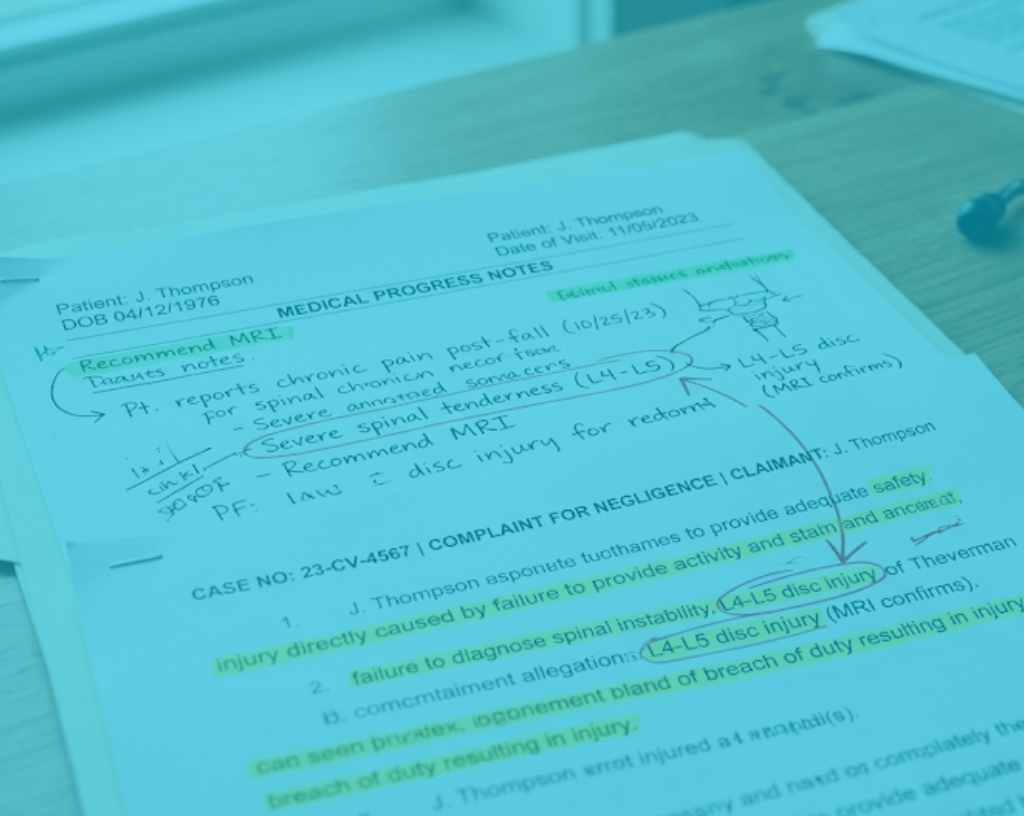
This case study demonstrates how Trivent Legal’s Case Intelligence Platform helped attorneys align medical evidence with liability arguments in a premises case, creating a clear and defensible connection between the incident and the resulting injuries.
Background
The case involved an individual who sustained injuries after a fall on a commercial property. The incident occurred due to a hazardous condition that had not been addressed by the property owner.
Following the fall, the individual received:
- Emergency medical evaluation
- Diagnostic imaging
- Follow up care with specialists
- Physical therapy and rehabilitation
The liability component of the case was supported by incident reports and witness statements. However, the medical records were extensive and spread across multiple providers.
While the injuries were documented, the connection between the fall and the treatment journey was not clearly structured within the records.
To strengthen the case, the attorney engaged Trivent Legal to organize and align the medical evidence with the liability narrative.
Attorney Challenge
The legal team faced several challenges:
- Medical records were fragmented across providers
- Treatment progression was not clearly linked to the incident
- Defense arguments could question causation
- Injuries needed to be tied directly to the hazardous condition
- The case required a unified narrative connecting liability and damages
Without alignment between liability and medical evidence, the case risked being presented as a collection of unrelated medical events rather than a direct result of negligence.
Trivent Legal’s Expert Intelligence Approach
1. Centralized Medical Record Structuring
All medical records were ingested into the Case Intelligence Platform and organized into a unified structure.
This included:
- Chronological sorting of records
- Standardization of provider documentation
- Linking records to specific treatment dates
This created a clear foundation for analysis.
2. Incident Anchored Medical Timeline
The platform anchored all medical events to the date of the fall.
The timeline clearly demonstrated:
- Immediate symptoms following the incident
- Early medical evaluation
- Diagnostic findings supporting injury
- Ongoing treatment progression
By placing the incident at the center of the timeline, all subsequent care was contextualized within the liability framework.
3. Linking Injuries to the Mechanism of Fall
Trivent Legal’s clinical analysts aligned documented injuries with the mechanics of the incident.
This included:
- Correlating fall dynamics with injury patterns
- Matching reported symptoms with clinical findings
- Identifying consistency between patient complaints and medical documentation
This step strengthened the causal relationship between the hazardous condition and the injuries.
4. Highlighting Treatment Progression as a Result of Injury
The platform mapped how treatment evolved after the fall.
Key elements included:
- Escalation from initial care to specialist involvement
- Continued symptoms requiring therapy
- Functional limitations documented over time
This progression demonstrated that the injuries were not isolated but required sustained medical attention.
5. Integrating Case Insights for Liability Strategy
The platform provided structured insights that helped attorneys:
- Identify strong causation points
- Address potential gaps in documentation
- Prepare for defense arguments
- Align medical evidence with liability claims
This transformed the medical record from raw data into a strategic asset.
Key Insights Revealed
The structured analysis revealed several important findings.
First, symptoms were documented immediately after the fall, establishing a clear starting point for the injury.
Second, diagnostic imaging and clinical evaluations supported the presence of injuries consistent with the incident.
Third, treatment progression demonstrated that the injuries required ongoing care and were not minor or temporary.
Finally, the continuity of symptoms and treatment reinforced the connection between the fall and the long term impact on the individual.
Litigation Value Delivered
The alignment of medical evidence with liability provided several strategic advantages.
Stronger Causation Narrative
The case clearly demonstrated how the incident led to the injuries and subsequent treatment.
Improved Case Clarity
Attorneys could present a unified story connecting liability and damages.
Enhanced Negotiation Position
The structured narrative strengthened the overall claim value.
Reduced Defense Leverage
Potential challenges to causation were addressed proactively.
Efficient Case Preparation
The legal team could quickly access relevant medical evidence tied to the incident.
Outcome
With the aligned timeline and structured insights, the legal team was able to present a cohesive narrative that connected the hazardous condition directly to the plaintiff’s injuries and treatment.
This clarity improved the attorney’s ability to argue both liability and damages, strengthening the overall case position during negotiations and preparation for litigation.
Counsel reported that the platform made it significantly easier to demonstrate the relationship between the incident and the medical evidence.
Conclusion
In premises liability cases, establishing negligence is only part of the challenge. The true strength of a case lies in clearly connecting that negligence to the injuries and their long term impact.
This case demonstrates how Trivent Legal’s Case Intelligence Platform helps attorneys align medical evidence with liability arguments. By structuring records, anchoring timelines to the incident, and providing clinical insights, Trivent Legal enables legal teams to present clear, compelling, and defensible cases.
Through Expert Intelligence, medical data becomes a strategic tool that supports stronger causation, clearer narratives, and more effective litigation outcomes.