Medical chronologies, demand letters, medical opinions, and billing summaries are foundational litigation tools. They organize records, clarify medical issues, and support valuation. But traditionally, once delivered, these reports remain static documents. Attorneys must manually extract strategy from them.
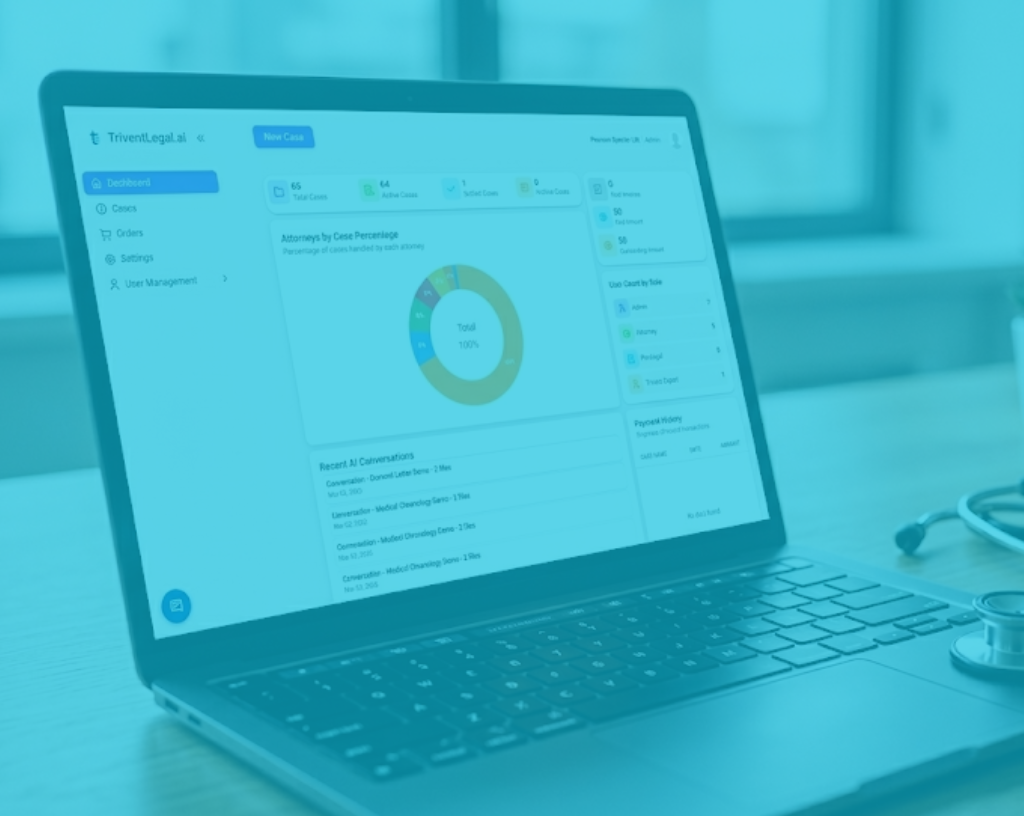
The AI Assistant within Trivent Legal’s Expert Intelligence Platform changes that dynamic. It allows attorneys to interact with expert prepared reports in real time, converting structured documentation into an active case strategy environment.
Instead of rereading hundreds of pages to locate a detail, attorneys can query the case directly.
The Limitation of Static Reports
Even well prepared reports have inherent limitations when used traditionally:
- Critical entries must be manually located
- Treatment gaps require timeline scanning
- Causation anchors must be identified through review
- Inconsistencies are often discovered late
- Strategic patterns are not immediately visible
Static reports require time intensive interpretation. In high volume or high exposure litigation, that delay can weaken responsiveness and increase risk.
What the AI Assistant Changes
The AI Assistant is built into the Expert Intelligence Platform and is available within all services. It allows attorneys to interact conversationally with their case documents, including expert prepared reports.
Rather than reviewing passively, attorneys can ask focused, litigation driven questions such as:
- What prior conditions may impact causation?
- Where are the documented treatment gaps?
- Which entries support permanent impairment?
- When did symptoms first escalate?
- Which provider notes may present vulnerability?
The Assistant analyzes the underlying expert prepared documentation and surfaces targeted answers instantly.
Turning Reports Into Strategy Tools
1. Instant Issue Spotting
The AI Assistant accelerates early case analysis by identifying:
- Causation strengths
- Timeline inconsistencies
- Missing follow ups
- Potential alternative causation references
This reduces the time between report delivery and strategic decision making.
2. Rapid Deposition Preparation
During deposition preparation, attorneys often need precise citations. The AI Assistant allows quick identification of:
- Specific dates and treatment entries
- Provider statements relevant to contested issues
- Escalation points in care
- Documentation supporting or contradicting testimony
This responsiveness enhances confidence under questioning.
3. Strengthening Settlement and Mediation Positioning
Negotiations frequently require real time access to supporting documentation. The AI Assistant enables attorneys to:
- Retrieve key entries instantly
- Confirm progression patterns
- Validate impairment references
- Clarify cost related discussions
Rather than relying on memory or manual searching, attorneys can respond with record backed precision.
4. Surfacing Hidden Patterns
Complex medical records often contain subtle trends that are difficult to identify manually. The AI Assistant helps surface:
- Symptom recurrence patterns
- Documentation inconsistencies across providers
- Frequency of specialty referrals
- Shifts from conservative to invasive treatment
This deeper visibility transforms information into insight.
5. Improving Internal Team Collaboration
Litigation teams often include partners, associates, and paralegals reviewing the same file. The AI Assistant allows:
- Faster onboarding of new team members
- Efficient review of case critical issues
- Consistent understanding of timeline events
- Reduced duplication of manual record review
This increases operational efficiency without sacrificing analytical depth.
Why This Matters in High Volume and Complex Litigation
In mass tort or catastrophic injury litigation, the volume of documentation can overwhelm even experienced teams. The AI Assistant provides:
- Scalable review capability
- Standardized issue spotting
- Faster case screening
- Greater consistency across large inventories
It transforms documentation from a review burden into a strategic advantage.
Built on Expert Prepared Foundations
The effectiveness of the AI Assistant depends on the quality of the underlying reports. Within the Expert Intelligence Platform, all reports are built by medical professionals, ensuring that the AI is interacting with clinically structured, litigation ready data.
This foundation ensures that responses are aligned with medical reasoning and litigation context, not generic summarization.
The result is not just automation. It is strategy driven interactivity grounded in expert prepared documentation.
From Document Delivery to Continuous Strategic Access
Traditionally, report delivery marked the end of the process. With the AI Assistant, report delivery becomes the beginning of strategic engagement.
Attorneys move from:
- Reading documents
to - Conversing with their case
This shift allows faster decisions, clearer positioning, and stronger control over litigation narratives.
Conclusion
Static reports provide structure. The AI Assistant transforms that structure into dynamic case strategy.
By enabling real time interaction with expert prepared reports, the Expert Intelligence Platform helps attorneys identify strengths, anticipate vulnerabilities, and respond quickly in negotiation and trial preparation.
In modern litigation, speed and clarity matter. The AI Assistant ensures that medical intelligence is not just delivered, but actively leveraged.