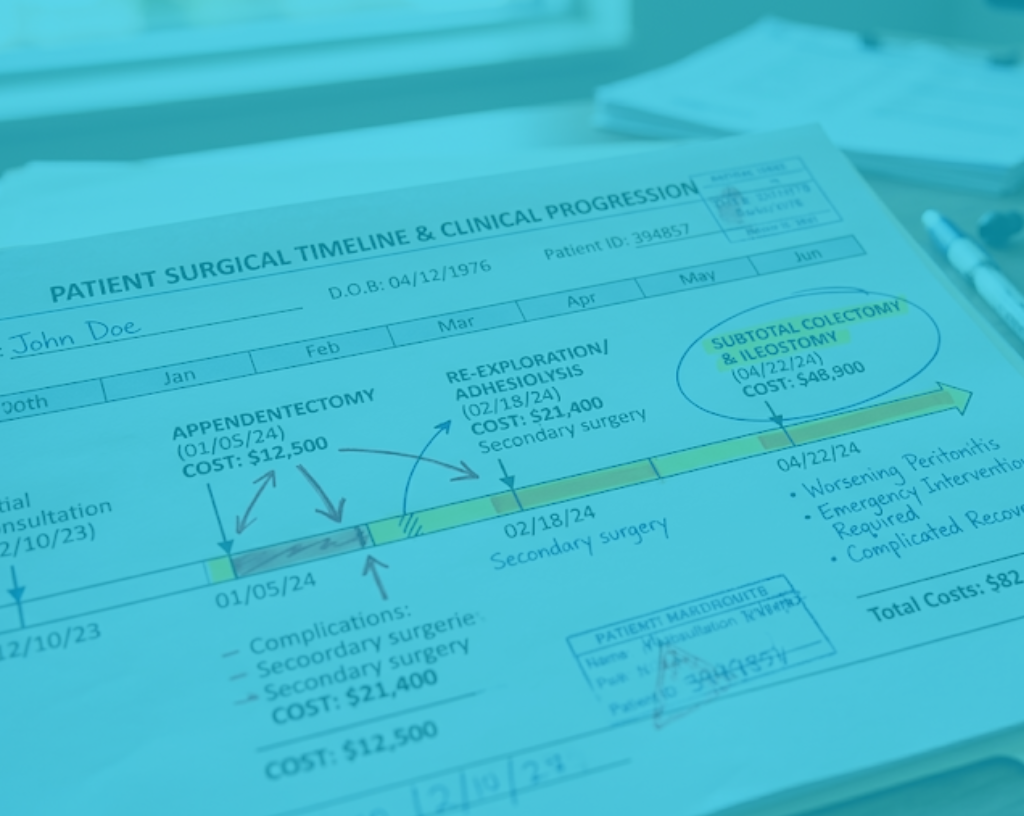
In personal injury and medical malpractice cases, the number of surgeries a plaintiff undergoes is often the clearest indicator of how an injury evolved and how deeply it has impacted their life. Yet, in litigation, simply stating “the client had multiple surgeries” is not enough. Defense counsel often reframes those same surgeries as “unrelated complications” or “voluntary corrective procedures.” To overcome that narrative, attorneys must present surgical data in a structured, medically supported format one that illustrates escalation, causation, and measurable economic loss. Trivent Legal transforms scattered surgical documentation into cohesive, evidence-based narratives that prove how each intervention ties directly to the original incident. Through precise medical chronologies, comparative summaries, and cost analyses, Trivent Legal enables attorneys to demonstrate not only what happened but why it matters in terms of liability, pain and suffering, and long-term damages.
Why Multiple Surgeries Strengthen a Plaintiff’s Case
Each surgical intervention serves as both a medical milestone and a legal datapoint. Multiple surgeries usually signify one or more of the following:
- Severe initial trauma requiring staged or complex repair.
- Complications arising from the original injury.
- Incomplete recovery due to continued physiological impairment.
- Permanent disability or disfigurement leading to lasting life changes.
When properly documented, this progression builds a powerful narrative that aligns directly with key elements of damages causation, pain and suffering, economic impact, and future loss projections.
Trivent Legal specializes in framing these details so attorneys can articulate, with clinical precision, how a case evolved from initial injury to surgical escalation.
Establishing the Chain of Causation
Defense teams often argue that surgeries performed months or years after the original incident were unrelated. Proving the link between each surgery and the defendant’s negligence requires a chronological, medically consistent account of treatment progression.
Trivent Legal’s Expert Intelligence process reconstructs this chain with clarity and accuracy:
- Baseline Injury Identification:
We begin by defining the nature and extent of the initial injury fracture, spinal compression, soft tissue rupture, or organ damage. This sets the foundation for understanding all subsequent interventions. - First Surgical Response:
Our analysts align operative reports, anesthesia notes, and postoperative documentation to show how the initial procedure directly addressed trauma caused by the event. - Postoperative Complications and Secondary Interventions:
We identify where complications emerged infection, nerve damage, mechanical failure of implants and correlate them with clinical follow-up notes and diagnostic imaging. - Cumulative Surgical Burden:
When multiple surgeries occur, our chronologies highlight the physiological and psychological toll. Each procedure adds recovery time, pain, and new medical costs all quantifiable elements of damages.
This layered narrative transforms what might appear as “repeated surgeries” into proof of escalating harm, demonstrating that each intervention was a necessary consequence of the defendant’s initial negligence.
Using Surgical Records to Demonstrate Escalating Harm
1. Detailed Chronology of Surgical Events
Trivent Legal compiles a medical chronology that organizes all surgeries, pre- and post-op visits, and treatment outcomes into a clear, sequential report. This includes:
- Procedure names and CPT codes
- Dates and facilities
- Surgeons involved
- Anesthesia reports
- Operative findings and complications
- Recovery outcomes
By integrating this data, attorneys can present a visual progression of worsening conditions a persuasive tool for mediation and trial.
2. Linking Diagnostic Imaging to Surgical Necessity
Our team reviews radiology reports, MRI findings, and CT scans to establish why each surgery was required. For instance, a post-accident MRI showing progressive disc herniation or failed fusion directly connects later surgeries to the original injury.
3. Mapping Clinical Escalation
We illustrate how treatment intensity increased over time from conservative management (therapy, injections) to invasive intervention (surgery, revision, or fusion). This escalation underscores the gravity of injury and supports claims for both physical suffering and loss of quality of life.
Quantifying Economic Loss Through Surgical Analysis
Each surgery not only represents physical trauma but also a major economic burden. Trivent Legal provides economic clarity by breaking down the costs associated with every surgical phase.
Direct Costs:
- Surgeon and anesthesiologist fees
- Facility and operating room charges
- Post-op medications and therapy
- Diagnostic and lab costs
Indirect Costs:
- Time away from work and lost wages
- Additional childcare or home-care expenses
- Long-term rehabilitation and assistive devices
- Diminished earning capacity
Using itemized billing data and cost projection models, Trivent Legal’s analysts calculate the true financial trajectory of surgical progression a crucial component in establishing non-economic and future damages.
When Surgeries Reveal Negligence or Compounding Errors
Not all surgeries represent progress. In some cases, the need for additional operations signals avoidable medical errors, such as improper surgical technique, delayed diagnosis, or inadequate postoperative care.
Trivent Legal’s review process identifies these red flags by:
- Comparing operative reports to standard procedural guidelines.
- Evaluating whether proper post-op monitoring occurred.
- Highlighting inconsistencies between treatment plans and clinical outcomes.
In malpractice cases, these findings become invaluable in proving that repeated surgeries weren’t just a result of injury severity they were evidence of continued negligence or substandard care.
Case Example: Surgical Escalation as Proof of Damages
A 42-year-old warehouse worker sustained a lumbar injury in a workplace fall.
- First Surgery: Microdiscectomy for L4-L5 herniation.
- Second Surgery: Spinal fusion six months later after failed pain control.
- Third Surgery: Hardware revision due to loosening and persistent neuropathy.
Using Trivent Legal’s chronology, the attorney demonstrated that each successive procedure stemmed from the original accident. The cost projection report quantified over $300,000 in medical expenses and a 40% permanent impairment rating, forming the basis for a seven-figure settlement.
This structured medical and financial linkage not only substantiated the claim but neutralized the defense’s argument that “subsequent surgeries were elective.”
How Trivent Legal Strengthens Attorney Strategy
1. Litigation-Ready Medical Chronologies
Our chronologies combine surgical precision with legal applicability. Each report clearly differentiates between primary injuries, surgical interventions, and subsequent complications making causation easy to prove.
2. Expert-Verified Insights
Every Trivent Legal analysis is backed by licensed medical professionals who understand both clinical documentation and litigation strategy. Attorneys receive physician-reviewed insights on the medical necessity of each procedure.
3. Cost Projection Integration
We integrate surgical data with Medical Cost Projection (MCP) reports, allowing attorneys to present comprehensive damages that include both past and future care.
4. Visual Case Exhibits
For mediation and trial, our team provides anatomical diagrams and treatment progression visuals that translate complex surgical data into easily understood evidence for juries and adjusters.
Turning Surgical Complexity Into Settlement Leverage
When insurance adjusters and defense attorneys face a well-structured medical chronology that maps each surgery to specific complications, it eliminates ambiguity. The case ceases to be about “how injured the plaintiff claims to be” and becomes about verifiable harm with measurable costs.
Trivent Legal’s Expert Intelligence framework equips attorneys to:
- Counter causation disputes with evidence-based surgical linkage.
- Quantify escalating medical and financial damages.
- Present expert-backed narratives that align with standard of care deviations.
- Secure faster, higher-value settlements through data clarity.
Conclusion
In high-value personal injury and malpractice litigation, multiple surgeries tell a story if they’re presented correctly. They are the medical footprint of the client’s suffering, the timeline of escalating harm, and the financial ledger of what negligence truly costs.
Trivent Legal transforms those surgeries from fragmented records into a cohesive narrative of cause, escalation, and consequence. Through structured chronologies, expert analyses, and data-driven valuation, we help attorneys prove what matters most that each procedure represents not just treatment, but undeniable evidence of ongoing harm and loss.
Partner with Trivent Legal to strengthen your next case with medical clarity that maximizes compensation and credibility.